Run Post to Generate NC Program card
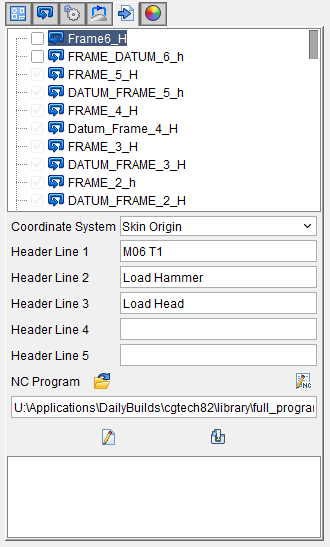
Post Sequence list — Contains a list of the sequences that have been defined for the NC Program. Select the sequence(s) you want to use to generate the NC program file.
💡 Tip: You can multi-select sequences with CTRL or SHIFT keys.
Coordinate System — Select which coordinate system will be used for the positions and direction vectors written to the NC Program. The drop-down list of coordinate system names will contain all those defined in the source file. While this card is selected, the chosen coordinate system's axes will be extended, with solid lines in their positive directions, and dashed lines in their negative directions.
Header Lines (1 through 5) — The content of these five fields is made available to the post-processor, which is responsible for formatting it and placing it as required in the NC Program file.
NC Program — In this field you can specify the location and name of the NC Program file which will be written when you click on the Run post to generate program button. The default location and file name are determined from the location ID of the first fastener defined for the selected sequence. The default extension is ".mcd".
 (Browse for NC Program file) — Displays the "NC Program" file selection window enabling you to specify the /path/filename of the NC Program to be created.
 (Edit NC Program) — Displays the selected NC Program in a new window where the NC program can be edited.
 (Run post to generate program) — Click on this button once you have set the post-processor parameters as desired to generate the NC program file. Only the selected sequences will be post-processed into the NC program file.
 (Simulate NC Program) — Click on this button to add the NC program to the project. The program will be listed under NC Programs in the Project Tree.
Post Card Tab Right Mouse Button Menu
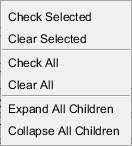
Check Selected — Enables the selected sequences for post-processing.
Clear Selected — Disables the selected sequences for post-processing.
Check All — Enables all sequences for post-processing.
Clear All — Disables all sequences for post-processing.
Expand All Children — Expands selected sequences.
Collapse All Children — Collapses selected sequences.
NC Program Editor
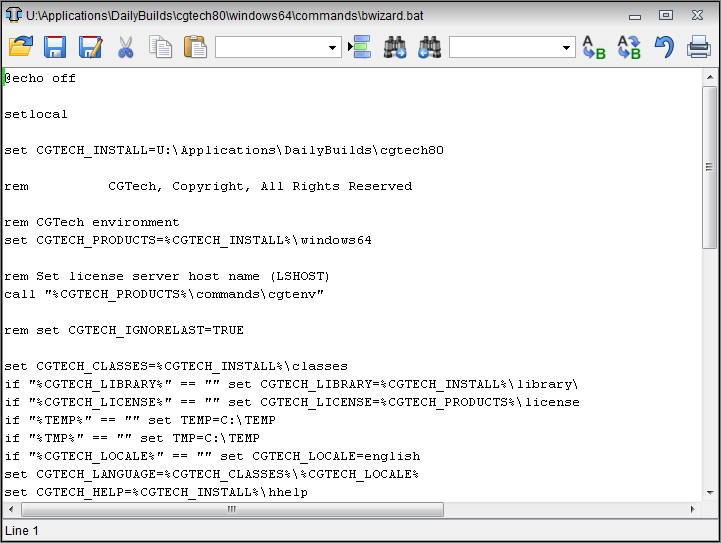
Selecting  displays a text editor window with the selected NC program file/subroutine file loaded and ready for editing. Standard text editing features are provided, such as: copy/cut, paste, search, etc.
⚠️ Warning: Editing the NC program file can cause undesirable results, especially when edits are made to portions of the NC program which have already been processed by Vericut. These edits can cause the NC program record number pointer to be out of sync with the edited NC program file. In these cases it is recommended that you rewind the NC program file after editing, and restart the simulation with the last unedited record prior to the first addition/deletion.
NC Program Ribbon:
The menu ribbon located at the top of the window provides easy access to major functions. Each menu contains groups of related functions. Left-click on any menu name in the menu bar to display the list of functions that are available in that menu. Click on the function in the menu you want to use. The name of the current file is also displayed in this area.

 Open File — Opens a file selection window enabling you to select another file.
 Save File — Save the current file.
 Save As — Save the current file under a different name.
 Cut — Cuts the highlighted text in the file listing and puts it in the paste buffer.
 Copy — Copies the highlighted text in the file listing to the paste buffer.
 Paste — Puts the contents of the paste buffer at the location of the cursor in the file listing.
Line Number or Search Text — Use this text field to enter a line number, or a string of text, to search for.
 Go to Line Number — Moves the cursor in the file listing to the line number specified in the Line Number or Search Text field.
 Search Forward — Searches forward in the file listing for the text string specified in the Line Number or Search Text field.
 Search Backward — Searches backward in the file listing for the text string specified in the Line Number or Search Text field.
Replacement Text — Use this text field to enter a "replacement text" string.
 Replace One — Replace one occurrence of text string in the Line Number or Search Text field (or the highlighted text in the file listing) with the text string in the Replacement Text field.
 Replace All — Replace all occurrences of the text string in the Line Number or Search Text field with the text string in the Replacement Text field.
 Undo Highlighted Changes — Restores the highlighted changes to the original state.
 Print — Print the file.
↘️ Shortcut: Right-click in the NC Program Edit window to display the following menu:
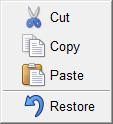
Cut, Copy, Paste and Restore provide the same functionality as those available in the ribbon.
💡 Tip: The NC Program Editor also supports Windows-like shortcuts for the up/down/left/right arrows, Home, End, Page Up, and Page Down keys with optional Control key and/or Shift key modifiers. The following describes the behavior for each action.
No modifier key:
Up arrow key — moves the cursor to the previous line.
Down arrow key — moves the cursor to the next line.
Left arrow key — moves the cursor left 1 character. The cursor wraps to the previous line if the cursor is at the beginning of the current line.
Right arrow key — moves the cursor right 1 character. The cursor wraps to next line if the cursor is at the end of the current line.
Home key — moves the cursor to the beginning of the current line.
End key — moves the cursor to the end of the current line.
Page Up key — moves the cursor up about a window's worth of text.
Page Down key — moves the cursor down about a window's worth of text.
Shift key:
Holding down the Shift key while using any of the above keys produces the same behavior described above for no modifier key except that it highlights the text from the previous cursor position (or start of highlighting) to the current cursor position.
Control key:
Holding down the Control (Ctrl) key while using any of the keys below produces the behavior described.
Up arrow key — if not at the beginning of the current line, acts like home key. Else, works like up.
Down arrow key — equivalent to pressing down and then home.
Left arrow key — jumps to the start of the previous word on the current line or to the end of the previous line if at the beginning of the current line.
Right arrow key — jumps to the start of next word on the current line or the beginning of the next line if at the end of the current line.
Home key — jumps to the first character of the first line of the document.
End key — jumps to the last character of the last line of the document.
Page Up key — jump to the first character of the first line in the current window.
Page Down key — jump to the last character of the last line in the current window.
Control + Shift keys:
Holding down both the Control (Ctrl) key and the Shift key while using any of the above keys produces the same behavior described above for Control key except that it highlights the text from the previous cursor position (or start of highlighting) to the current cursor position.
Editing an NC Program File
Vericut provides a fast and easy way to edit your NC program files. All standard text editing features are supported, such as: copy/cut, paste, search, etc.
To edit an NC program file in the current Project file:
-
Click
to display the desired NC program file in the NC Program editor. -
Edit the file as desired.
- When finished editing the file, select Save in the NC program editor window ribbon to save the changes in the existing NC program file or select Save As in the NC program editor window ribbon to display the Save As file selection window and use it to specify the /path/filename of a new NC program file where you want the modified NC program file saved.
⚠️ Warning: Editing the NC program file can cause undesirable results, especially when edits are made to portions of the NC program which have already been processed by Vericut. These edits can cause the NC program record number pointer to be out of sync with the edited NC program file. In these cases it is recommended to rewind the NC program file after editing, and restart the simulation with the last unedited record prior to the first addition/deletion.