PTC Creo Parametric-to-Vericut Interface (PROEV)
Overview
PROEV is a licensed software tool that facilitates the seamless transfer of manufacturing data from Creo Parametric to Vericut
Software Requirements for Creo Parametric Interface
Licensing Requirements
CGTech Licensing:
PTC Creo Parametric Interface
Installation & Configuration: Creo Interface
PROEV Installation Overview
When installing CGTech software, the necessary PROEV Interface files are placed in a subfolder within the installation directory:
C:\Program Files\CGTech\Vericut x.x.x\windows64\proev\version
Installation Steps Copy the protk.dat File Move the protk.dat file into the Creo shortcut’s Start In directory.
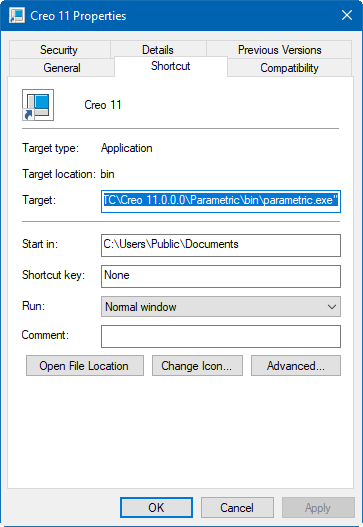
Creo's Startup Behavior
At launch, Creo Parametric searches for the protk.dat file in the following order:
- The Start In directory
- \Creo\MACHINE\text
- \Creo\text
Why this matters: This ensures that Creo can find the interface information it needs during launch. This file tells Creo where to find the required interface components.
Configure the protk.dat
This file must point to the correct DLL and text directories. The base structure looks like the below:
name cgtproev
startup dll
exec_file <full path to cgtproev.dll>
text_dir <full path to proev.txt>
revision Wildfire
end
Replace placeholder paths with the actual paths in your installation.
For example:
name cgtproev
startup dll
exec_file C:\Program Files\CGTech\Vericutx.x.x\windows64\proev\Creoxx\cgtproev.dll
text_dir C:\Program Files\CGTech\Vericutx.x.x\windows64\proev\Creoxx\text
revision Wildfire
end
Environment variables: Creo Interface

To enable the Creo Interface to locate the necessary Vericut files, the following environment variables must be defined:
Environment Variables: Description & Example
CGTECH_INSTALL
Purpose: Defines the Vericut installation folder.
Example: For Vericut 9.7, set to: C:\Program Files\CGTech\Vericut 9.7
CGTECH_PRODUCTS
Purpose: Specifies the folder for the operating system running Vericut (windows64).
Example: For Vericut 9.7, set to:
C:\Program Files\CGTech\Vericut 9.7\windows64
LSHOST
Purpose: Defines the name of the license server computer.
Example: localhost
CGTECH_SINGLE_PLATFORM (Optional)
Purpose: Specifies if Vericut is running on a single platform.
Example: CGTECH_SINGLE_PLATFORM=YES
PROEV_LANGUAGE (Optional)
Purpose: Allows the interface to use a localized language file instead of US English.
Note: The application also provides the option to change the language directly from within the user interface.
Available Languages: French, German, Italian, Portuguese, Chinese and Japanese.
Example PROEV_LANGUAGE=
C:\Program Files\CGTech\Vericut 9.7\windows64\proev\Creoxx\ProevFrench.local
PROEV_PATH (Optional)
Purpose: If you want to use a system variable to set the path to the exec_file and text_dir, set PROEV_PATH and call it in the protk.dat file.
Example: For Vericut 9.7, set to:
C:\Program Files\CGTech\Vericut 9.7\windows64\proev\Creoxx
name cgtproev
startup dll
exec_file \$**PROEV_PATH**\cgtproev.dll
text_dir \$**PROEV_PATH**\text
revision Wildfire
end
CGTECH_PROEV_TDP_ADJUST (Optional)
Purpose: Set to activate logic which will ensure that the X and Z driven points are negative when the following three requirements are met...
1. The environment variable CGTECH_PROEV_TDP_ADJUST is set to "1".
2. The tool is a lathe tool.
3. The tool is on head 2
Example: CGTECH_PROEV_TDP_ADJUST=1
CGTECH_PROEV_ONLY_HOLDERS (Optional)
Purpose: If you want to have tools without cutting portion also transfered to Vericut, set this variable to true.
Example: CGTECH_PROEV_ONLY_HOLDERS=true
Set up a Vericut icon: Creo Interface
To add an icon to the Toolbar
The proev.txt file contains the resource text for the Vericut option which shows up in Creo under the "Applications" menu. The Vericut option is the entry point for launching the Creo-to-Vericut Interface.
Steps to add the Vericut  icon to the Creo Ribbon
-
Edit the proev.txt file and set Vericut
Reference: C:\Program Files\CGTech\Vericut x.x.x\windows64\proev\Creox.x\text -
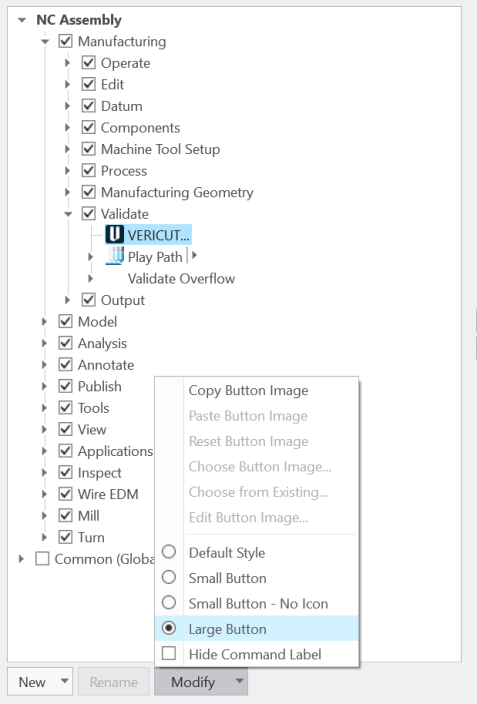
Select Customize Quick Access Toolbar > More Commands..
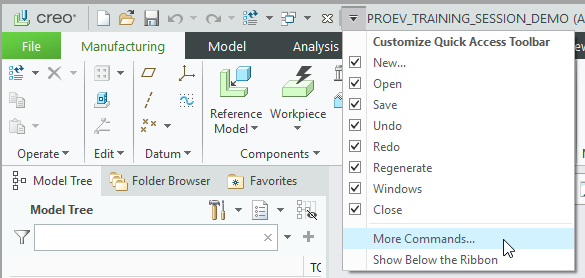
-
Customize: Ribbon
- Category: All Commands (Note: you may need to set TOOLKIT Commands)
- Filter Commands: Vericut
-
Menu Validate
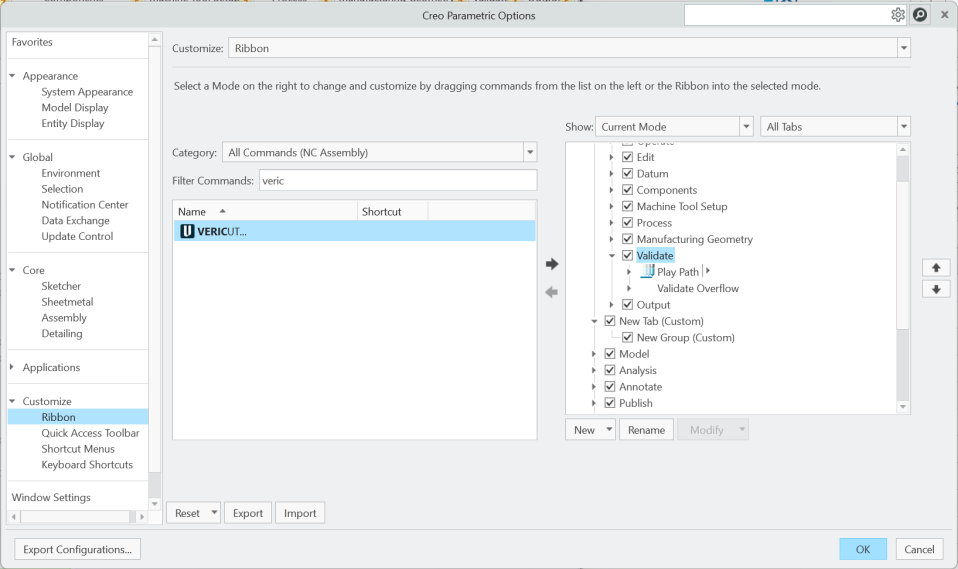
-
Use
 arrow to add Vericut to the desired location
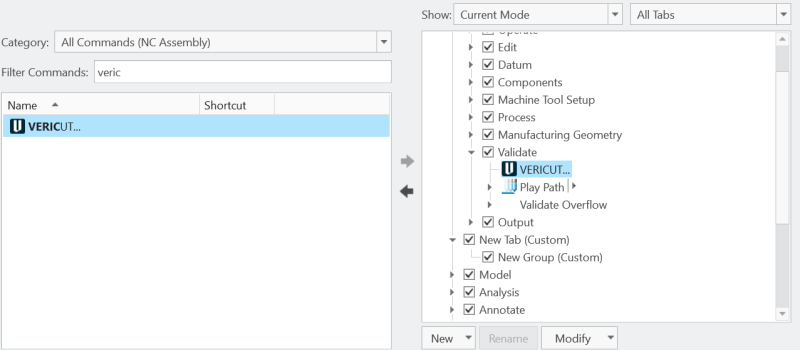
-
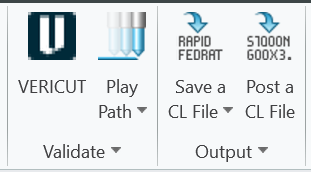
Select Modify > Large Button
-
Select Modify > Choose Button Image... and browse the Vericut32.gif
Reference:
C:\Program Files\CGTech\Vericut x.x.x\windows64\proev\Creox.x\text\resource
-
Select OK
Microsoft Redistributables: GibbsCAM Interface
The Creo Parametric-to-Vericut Interface (PROEV) may require the installation of Microsoft Redistributables, specifically the Windows C++ run-time libraries. These libraries ensure compatibility and proper functioning of the interface, allowing seamless data transfer between Creo and Vericut for manufacturing simulation.
Note: A runtime library is a collection of low-level compiler support routines and functions that are used by virtually all programs compiled with GCC (GNU Compiler Collection) and can be downloaded here.
Documentation: Creo Interface
Overview: The Creo interface exports manufacturing data from Creo to Vericut, ensuring a seamless transition for simulation. It automatically configures the necessary Vericut setup requirements and launches the simulation, ready to play.
Vericut Simulation Setup Requirements: To run a successful simulation in Vericut, the following steps must be completed:
1. Select a VMC (Vericut Machine Configuration) – Define the machine setup for simulation.
2. Select and Orient Stock, Fixture, and Design Models – Ensure correct positioning of components.
3. Select NC Programs & Subroutines – Load the necessary machining programs.
4. Define Cutting Tools – Specify the tools used in the machining process.
5. Define Work Offsets Tables – Configure coordinate systems for accurate machining.
Accessing the Creo-to-Vericut Interface
To connect Creo with Vericut, follow these steps:
The Interface is activated by clicking Vericut  icon
icon
Important Note: The Creo interface requires an active NC Manufacturing file to function properly with Vericut.
When you trigger PROEV, you should see a window similar to this:

License Handling
- The interface checks out a license when Generate, Run, or Generate & Run is executed.
- The interface checks in the license upon completion of data export.
Main Dashboard
Click  to close the Vericut dashboard. Click
  to reset the Custom Data and close.
File
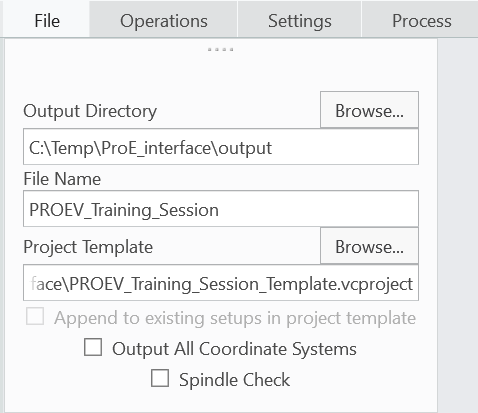
PROEV will generate several files to pass Creo information to Vericut. For verification or simulation of a Creo manufacturing assembly, the following can be created; - Vericut template file (*.VcTmp) - Vericut Tool libraries (*.tls) - Vericut Operation file (*.ops) - Model files (*.stl and *.ply)
The Output Directory specifies the directory where you want the Vericut files to be written (.VcTemp, .tls, .ops, .ply, .stl). Type the Output Directory, or use the "Browse" button to display a file selection window to select the path.
The File Name specifies the "base" name for all Vericut files that will be created.
The files generated by PROEV are intended to be "add-ons" for existing Vericut projects that contain much more detail than is present in a Creo manufacturing assembly. For example, you may have a machine and control fully specified in a project file, and simply wish to place the Creo manufacturing assembly stock and fixtures on this machine before verifying the new NC programs. In this field you can specify the Project Template file. Type the Project Template, or use the "Browse" button to display a file selection window to select the Vericut project template.
NOTE: The machine file, specified in the Project Template file, is used to extract all components and subsystems on the machine.The machine file is opened as it is defined in the template file. If it is not found, then the machine file is searched for in the same directory as the template file. If it does not exist in the same directory as the template file, then the machine file is searched for in the directories specified by the CGTECH_LIBRARY environment variable.
If you wish to append the part operations from a Creo manufacturing assembly to the setups that are already defined in your project template, you can click on the Append to existing setups in project template check-box under the template field. Otherwise, and more typically, the imported part operations will be the only setups in the generated project. If you wish to transfer all Creo part coordinate systems to Vericut, then you can click on the Output All Coordinate Systems check-box. This feature will output all coordinate systems in relationship to the Creo world or Absolute system.
Spindle Check, In Creo it is now possible to know on which spindle a Fixture, Stock and Design are mounted for an operation. You only know which Csys is associated at each spindle. When Spindle Check check-box is toggled on, a Head/Subsystem assignment check is performed allowing the user to trigger the spindle axes recognition logic.
Operations
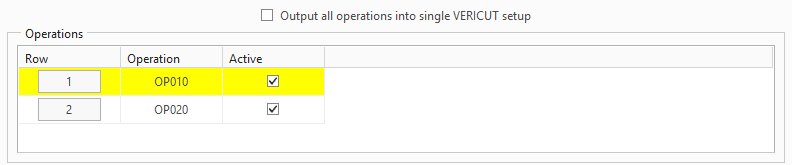
The Operations Table displays all operations in the Creo manufacturing file. The currently highlighted operation is the operation in which all operation dependent settings will apply. To select an operation, press the button in the column labeled "row". Only one operation can be selected at a time. An operation can be active or inactive by toggling on/off the check box in the column labeled "Active'. Only active Operations will be exported to Vericut.
Output all operations into a single Vericut setup When toggled "on" (checked), PROEV will combine all the Creo operations into a single Vericut setup.
Note: From the operations page, all operation dependent setting scan be specified.
Setup Template
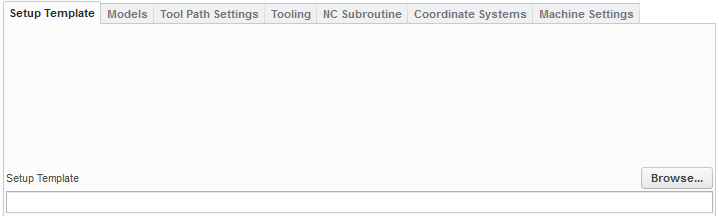
If all part operations in the Creo manufacturing assembly use the same machine, and that machine is defined in the project template file,then the setup template field can be left blank. If there are several machines involved, you will need to have a Vericut project file for each one, and will specify which file each setup should use in this field.
Models

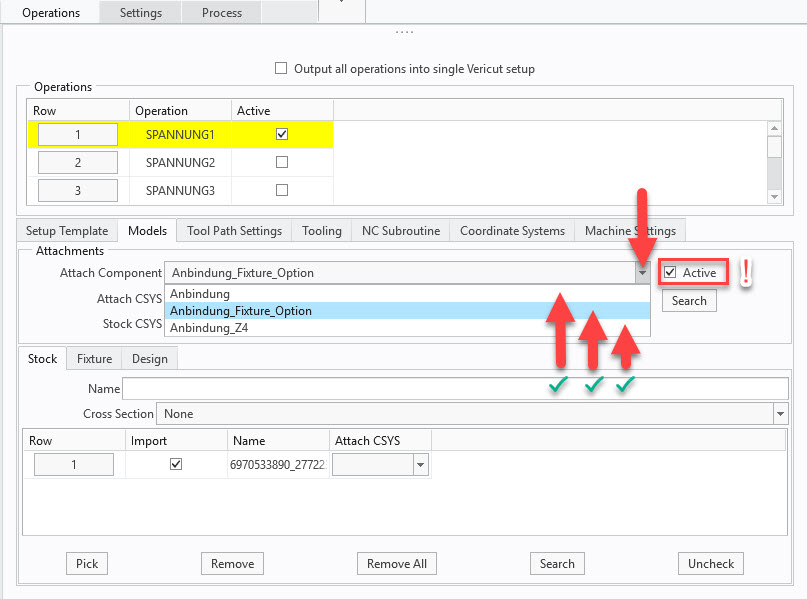
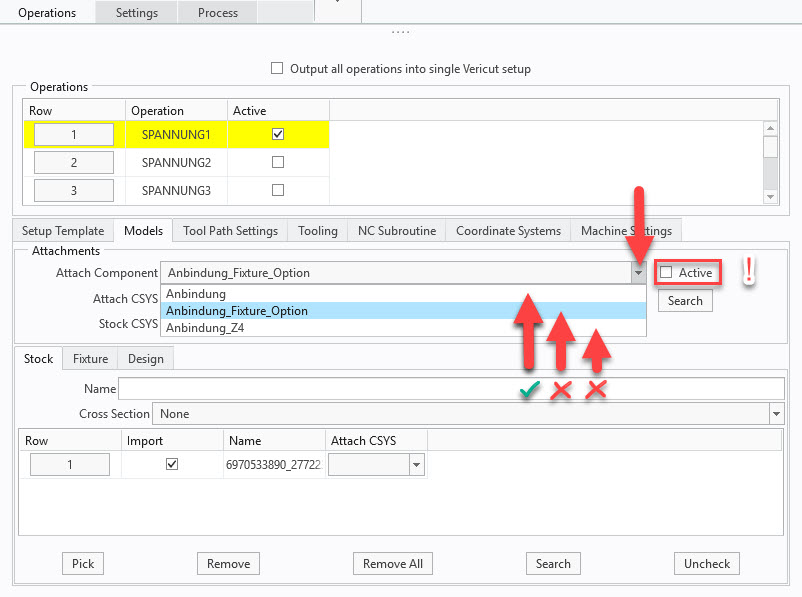
The attach components are read from the machine file that is specified in the project template (or from the machine file specified in the setup template if defined) and presented in a pull down list called Attach Component. For each attach component, a set of models can be specified. Also for each attach component an Attach CSYS, StockCSYS, fixture name, stock name, design name, stock cross section and design cross section can be specified. All attach components are active by default. The user can prohibit an attach component from being processed by unchecking the Active check box.
In this example the selected models will export to all Attach Components
In this example the selected models will export to the first Attach Component
Attach CSYS is the Creo coordinate system that is associated with the Vericut Attach Component.
The Search button is the global search button and will populate all three Stock, Fixture and Design tables. Whereas, the Search button at the bottom of window is used to only populate the table for the tab that is currently viewable.
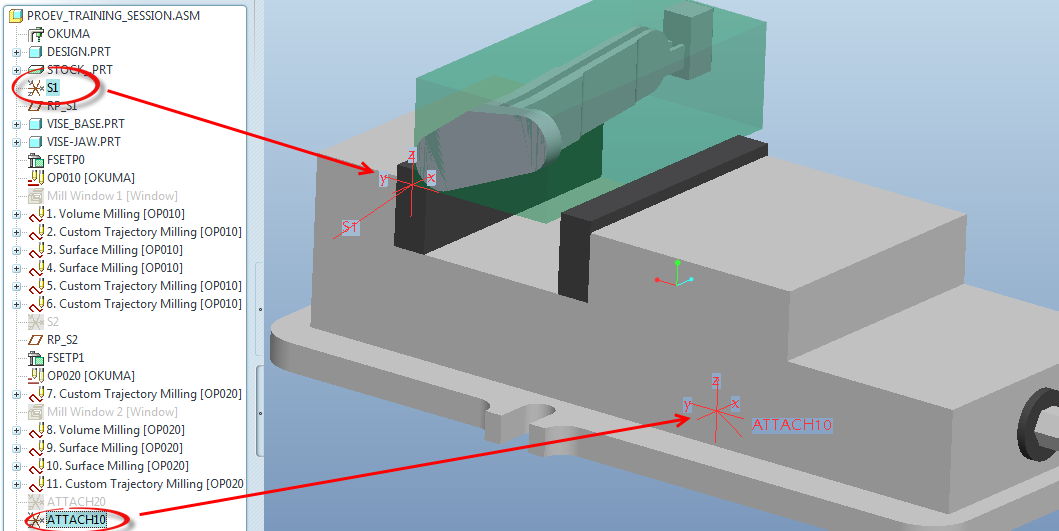
NOTE: in Pro/E the ATTACH10 coordinate system is positioned to represent the location of the Vericut Attach component.
If Stock CSYS is specified, then the relationship between the Attach CSYS and the Stock CSYS is used for transitioning between Vericut setups, else the relationship between the current Attach CSYS and the Attach CSYS from the first operation issued.
PROEV/Creo:
PROEV generates these coordinate systems with the data provide by the Stock CSYS field. In PROEV the same coordinate systems is selected twice, once per operation.
Operation OP010
Operation OP020
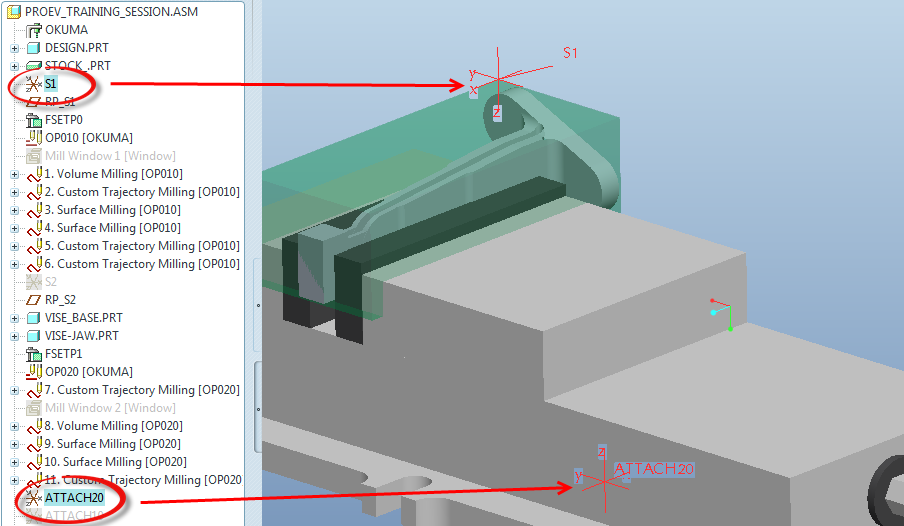
NOTE: Example of Pro/E -- PROEV -- Vericut process to transition the Cut Stock between setups
Stock
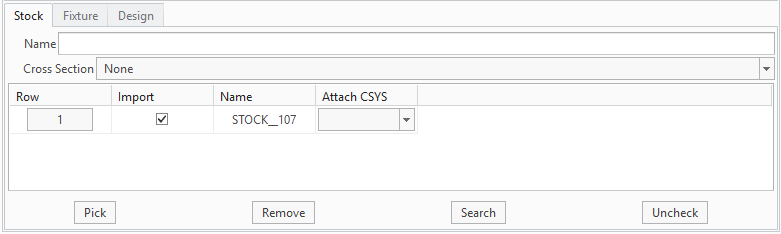
For each attach component, a set of stock models can be specified. Also, for each attach component, a stock name, and stock cross section can be specified. The Pick button can be used to graphically pick multiple models/assemblies using the mouse. The Remove button can be used to remove models from the list. The Search button can be used to populate the list.
If the “Attach CSYS” is set to a spindle axes, then the search button will only populate the table with the models associated with the specified spindle axes. If the “Attach CSYS” is not set to a spindle axes, then the search button will populate the table with all models. The Import column allows the user to prevent models from being transferred. The Uncheck button can be used to toggle off all Import toggles. If the Attach CSYS at the model level is not blank, then it overrides the Attach CSYS at the Attachment level.
Note: in Creo the ATTACH10 coordinate system is positioned to represent the location of the Vericut Attach component.
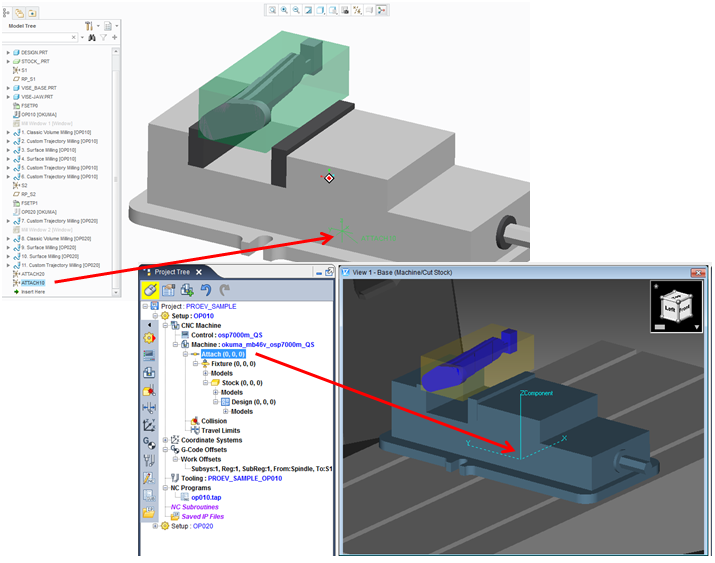
Note: Cross sections must be created at the part level and not at the assembly level. Load part, create cross section, save part, and then load manufacturing assembly.
Fixture
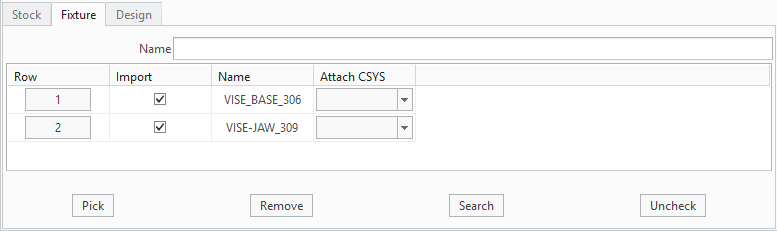
For each attach component, a set of fixture models can be specified. Also, for each attach component, a fixture name can be specified. The Pick button can be used to graphically pick multiple models/assemblies using the mouse. The Remove button can be used to remove models from the list. The Search button can be used to populate the list.
If the “Attach CSYS” is set to a spindle axes, then the search button will only populate the table with the models associated with the specified spindle axes. If the “Attach CSYS” is not set to a spindle axes, then the search button will populate the table with all models. The Import column allows the user to prevent models from being transferred. The Uncheck button can be used to toggle off all Import toggles. If the Attach CSYS at the model level is not blank, then it overrides the Attach CSYS at the Attachment level.
Design
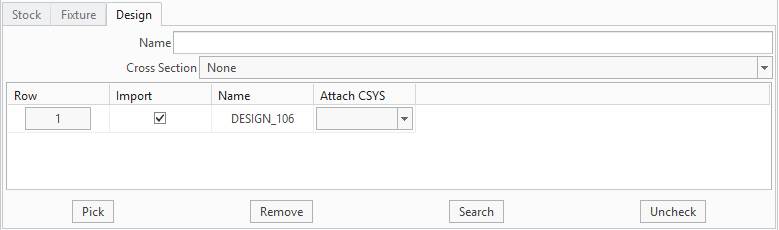
For each attach component, a set of design models can be specified. Also for each attach component, a design name, and design cross section can be specified. The Pick button can be used to graphically pick multiple models/assemblies using the mouse. The Remove button can be used to remove models from the list. The Search button can be used to populate the list.
If the “Attach CSYS” is set to a spindle axes, then the search button will only populate the table with the models associated with the specified spindle axes. If the “Attach CSYS” is not set to a spindle axes, then the search button will populate the table with all models. The Import column allows the user to prevent models from being transferred. The Uncheck button can be used to toggle off all Import toggles. If the Attach CSYS at the model level is not blank, then it overrides the Attach CSYS at the Attachment level.
Cross sections must be created at the part level and not at the assembly level. Load part, create cross section, save part, and then load manufacturing assembly.
Tool Path Settings
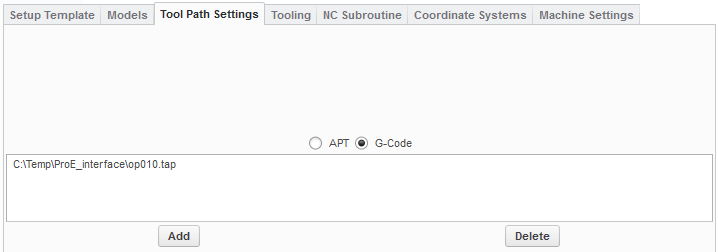
Specify whether the NC programs to be passed to Vericut are APT or G-Code. Use the "Add" button to browse for and add a tool path to the list. Use the "Delete" button to delete a tool path from the list. It is important to ensure that the list is in the order of cutting.
Tip:
Add the wild card filter (*) to the preference file (C:\Users\username\proev_creoxx_user.prefs) filters... to make it easier to find files
Tooling
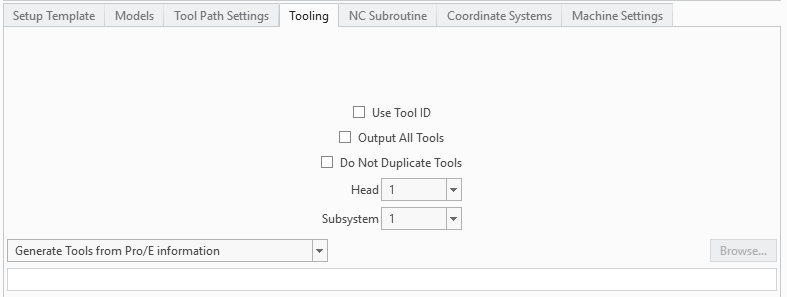
If the Use Tool ID check box is toggled on, then the tool ID is used directly in The Vericut Project, else the tool list is used. Select which Head from the choice list. Select which Subsystem to use for the Head from the choice list.
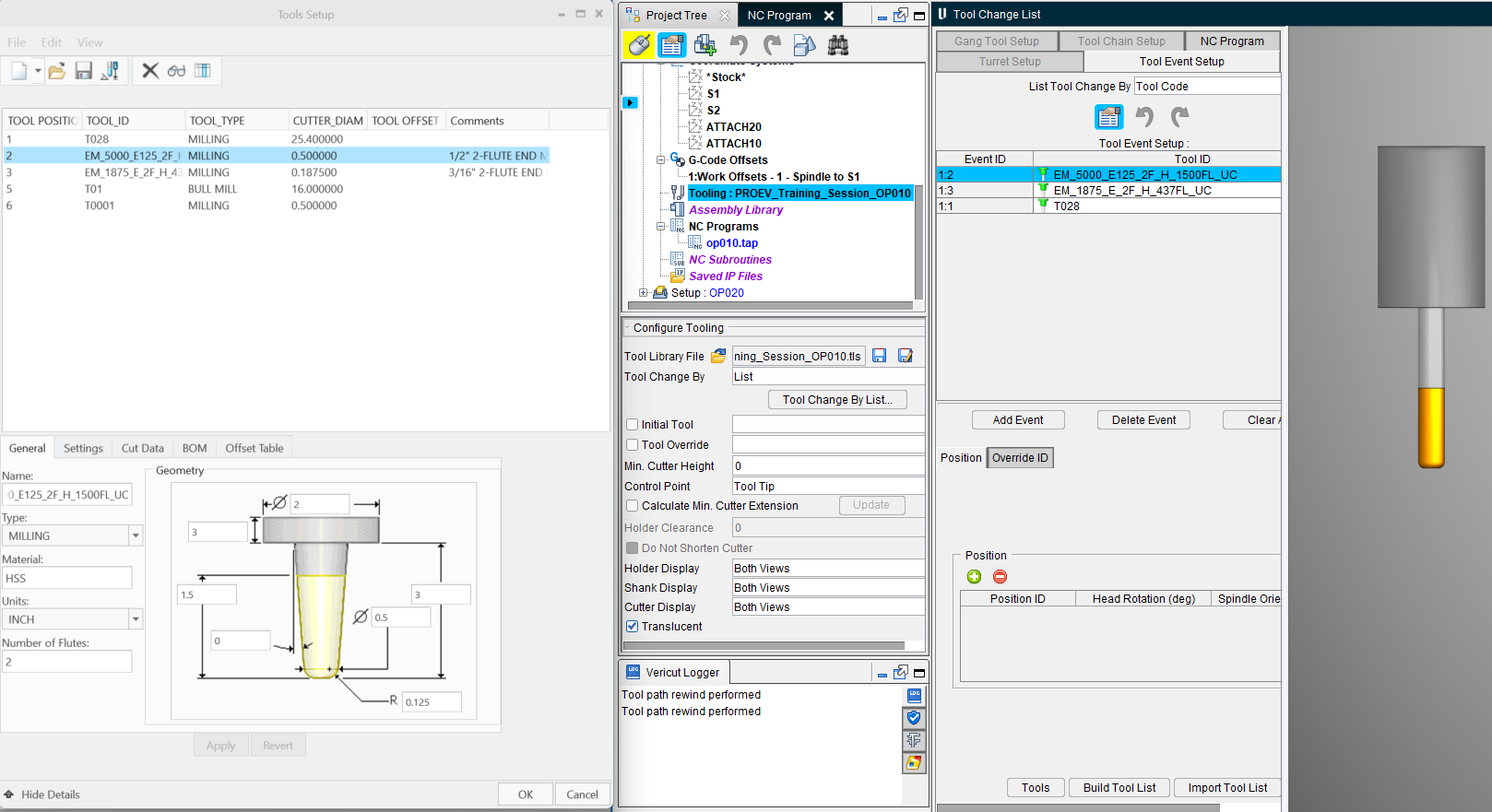
Tools are created and written to the tool library using the Creo tool “Name”. A Tool Change list is created in the project file which associates the Creo tool “Name” and the Creo “Tool Number". If the tool path is referencing the tool by the Creo tool “Name,” then the “Use Tool ID” must be toggled off. If the tool path is referencing the tool by the Creo “Tool Number", then the “Use Tool ID” must be toggled on.
A tool will exist in the Tool Change list for each of the subsystems associated with Head 1 and Head 2.
The Output All Tools option is used to output all tools that are loaded into the CREO virtual machine.
If the Do Not Duplicate Tools check box is toggled on, then tools referenced by multiple NC Sequences will only be output once in the tool library file. Default behavior is that a tool will be output to the tool library file for each instance it is referenced by an NC Sequence.
Select which subsystem to use for head 1 from the Head 1 Subsystem ID choice list. Select which subsystem to use for head 2 from the Head 2 Subsystem ID choice list.
Select one of the following options from the pull-down list: - Generate Tools from Creo information --- Choose this option to have Creo create a tool library using the tool data in Creo.
-
Use Selected Tool Library --- Choose this option to specify a specific tool library to use. Enter the \path\filename of the tool library file in the text field or use the Browse button to display a file selection window and use it to specify the \path\filename of the tool library file.
-
Use Tools from the Setup Template --- Choose this option to use the tool library file stored in the Setup Template instead of one created by PROEV.
-
Merge Tools into Setup Template Tool Library --- Choose this option to merge the tool library created by PROEV, with the tool library file stored in the Setup Template, and use the "merged" tool library rather than one created by PROEV.
If Use Selected Tool Library is selected, then type the tool library name in the text field or use the "Browse" button to display a file selection window to select the tool library file
Holders In Creo, holders can be defined as a parametric holder or a solid holder.
In order for the 3D holders to be recognized by Creo, the working directory must be set to the directory in which the 3D holders reside.
For solid holders, it is mandatory to create a local coordinate system, called “ATTACH,” at the location of where the tool connects to the holder.
Cutter Compensation The user can define one or more cutter compensation parameters for each tool. The cutter compensation parameter must be defined as CUTTER_COMP_VALUE_xx, where "xx" is a number in the range of [1..5]. The user can define one or more driven point parameters for each tool. The driven point parameter must be defined as TOOL_LENGTH_VALUE_[XYZ]_xx, where "xx" is a number in the range of [1..5].
Cutting Tool assemblies export from the Recourses menu > Tools
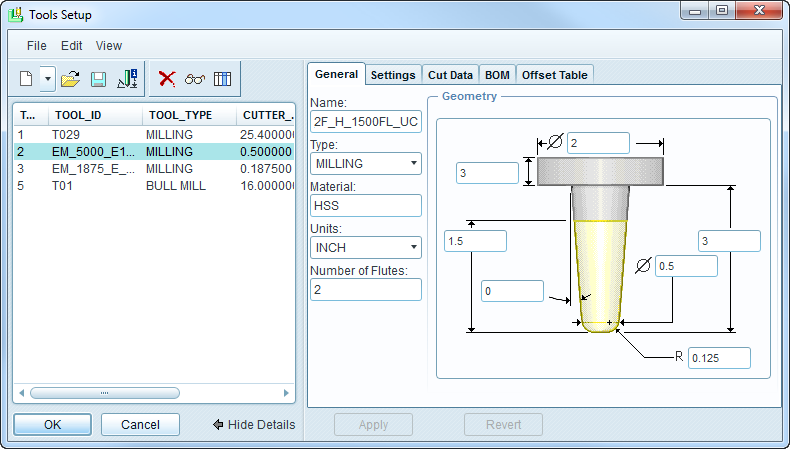
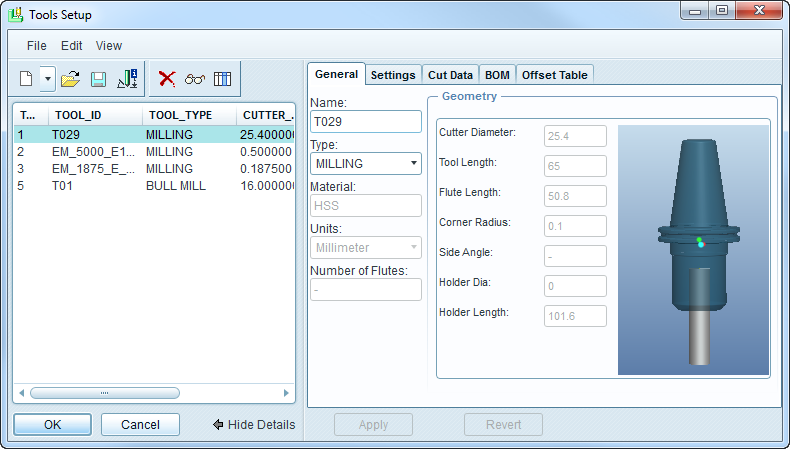
For all parametric milling tools, PROEV will check to see if a tool "attachment" is defined in the NC sequence for that tool and if defined, it will use the defined "attachment" as the tool's holder.
The 3D holders (.prt) must have the following defined...
- Vericut_TYPE=HOLDER
- SPINDLE_CONTROL_POINT
- TOOL_ATTACH_POINT
Note: By default, all solid model (non-parametric) milling/lathe tools are represented by a corresponding polygon (tessellated) file. The resolution for tool holders is controlled by Fixture tolerance setting
PROEV tooling logic for revolved tools
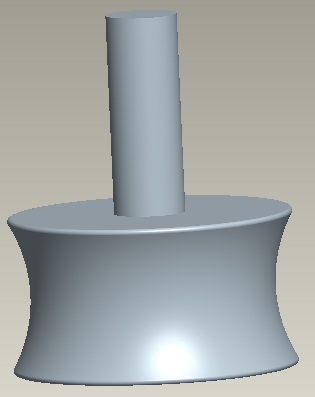
The user can override the polygon representation creation for milling tools by creating a cross section for the tool called Vericut_REVOLVE.
1. Load milling cutter part.
2. Create cross section named Vericut_REVOLVE.
3. Save milling cutter part.
Note: Cross sections must be created at the part level and not at the tool assembly level.
PROEV new tooling logic for inserts:
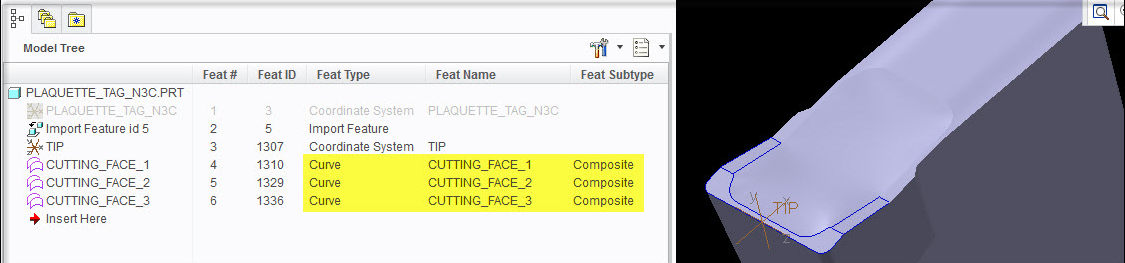
Used in milling or lathe tools was implemented to handle cutting face contours. The logic allows for multiple cutting faces per insert.
Cutting face contour requirements:
- Feature Type = "Curve"
- Feature Subtype = "Composite"
- Feature Name = "CUTTING_FACE"
The first 12 characters of "Feature Name" must be "CUTTING_FACE". The logic ignores all other characters beyond the twelve character. The user can postfix the "Feature Name" with whatever they want for their own identifying purposes.
If an insert does not have any cutting faces defined, then the insert will be output as a polygon model only.
Note: The old logic that tried to extract contour data from "sketched" curves is no longer supported. Please use new logic.
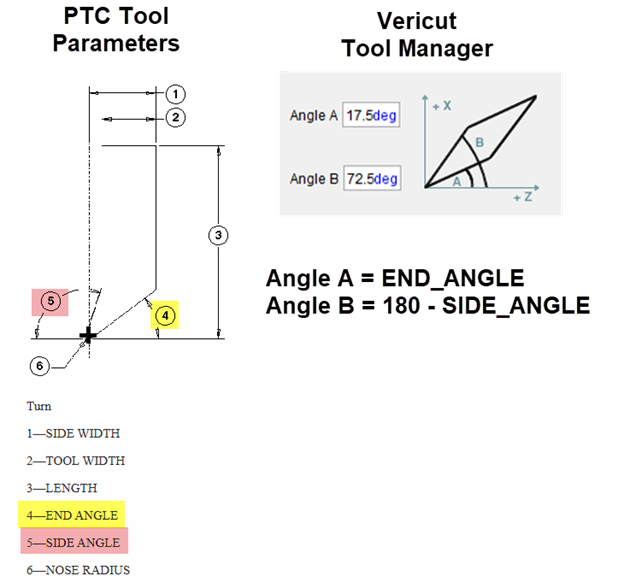
PTC Tool Parameters End Angle and Side Angle Exporting PTC Tool Parameters End Angle and Side Angle to Vericut Angle A and Angle B are supported for turning tools. The method of implementation is as follows...
NC Subroutine
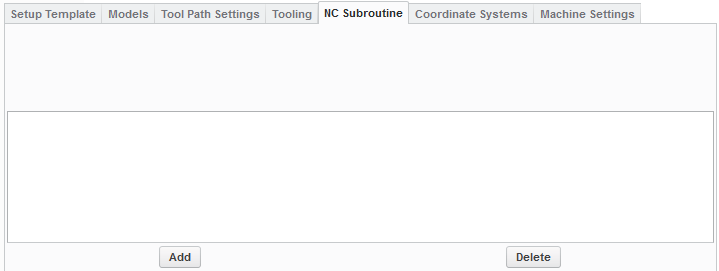
If you have G-Code programs that reference subroutines, you can use the "Add" button to browse for and add subroutine files to the list. Use the "Delete" button to delete subroutine files from the list.
Coordinate Systems
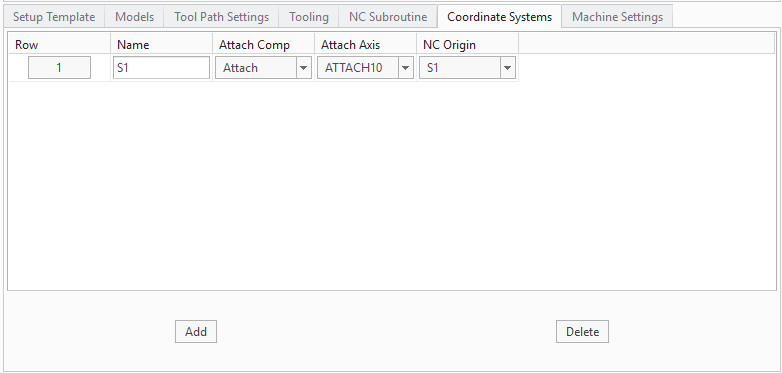
The Coordinate Systems list allows for the definition of a coordinate system that defines the relationship between an Attach Axis System and the NC Program Origin. Use the Add button to create a new coordinate system. A default coordinate system Name is assigned when created and can be changed and must be unique. The Attach Component is the Vericut component in which the coordinate system will be attached to. The Attach Axis System and the NC Program Origin are Creo Axis Systems. To select a coordinate system, press the button in the column labeled "row". To unselect a coordinate system, press the button in the column labeled "row". Multiple coordinate systems can be selected at a time. Use the Delete button to delete all selected coordinate systems.
Machine Settings
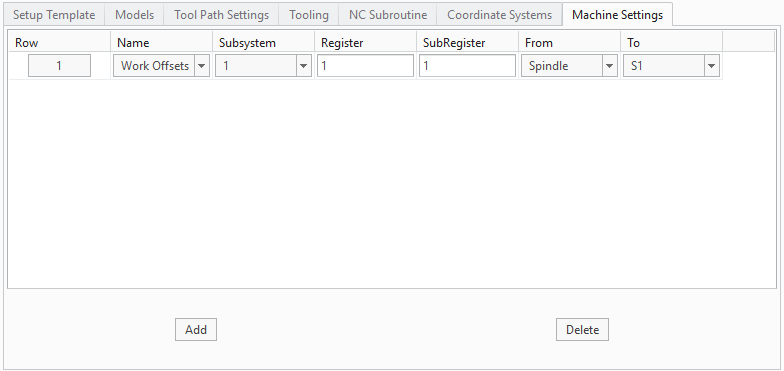
The Machine Settings list allows for the definition of work offsets which defines the relationship between the 'From' Component and the 'To' CSYS. Use the Add button to create a new work offset record. Table name can be Program Zero, Work Offsets, or Base Work Offset. Set the appropriate Subsystem ID, Register Number and Subregister Number. The 'From' Component is a Vericut component. The 'To' CSYS is a coordinate system defined in the Coordinate Systems list. To select a work offset, press the button in the column labeled "row". To unselect a work offset, press the button in the column labeled "row". Multiple work offsets can be selected at a time. Use the Delete button to delete all selected work offsets.
Settings
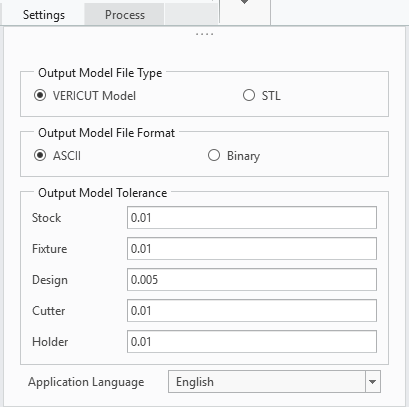
Use Output Model File Type to specify the type of model files that are created and passed to Vericut. Choose either Vericut Model (Vericut polygon file) or STL (Stereolithography model file).
Use Output Model File Format to specify the file format of the model files. Choose either ASCII or Binary. NOTE: \"Binary\" Vericut polygon files are platform specific.
Use the Output Model Tolerance to specify tolerance values for Stock, Fixture, Design, Cutter and Holder models.
The Application Language list allows for the selection of a native language. CGTech Products allows you to change the directory used to launch Vericut/Optimizer from the interface. This directory is initialized by the CGTECH_PRODUCTS and CGTECH_VO_INSTALL environment variables. The Product Launch allows you to select to launch the desired application, Vericut or Optimizer
Generate buttons
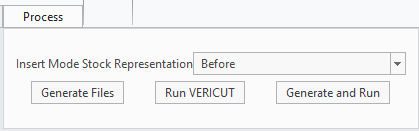
Set the Insert Mode Stock Representation choice list to Before, After or Manual. If Before is selected, then the "Insert Here" will be moved right before the first Material Removal Feature. If After is selected, then the "Insert Here" will be moved right after the operation currently being processed. If Manual is selected, the "Insert Here" is not moved. This allows the user to manually move the insert.
When you have provided PROEV with all the information it needs, you can perform the transfer of data to, and triggering of, Vericut. Click on the "Generate files" button to create the appropriate files without triggering Vericut. Once you have all the files needed, you can fire up Vericut with the "Run" button.
You can perform both of these steps at once with the "Generate and Run" button.
Preferences
Preferences File
Also known as 'prefs' file, stores all user specified 'global' settings for interface operation. The settings stored are called 'global' because they are responsible for overall look & feel and operational behavior of the interface. They are not tied to any specific Pro/E project. By default, 'Preferences' file is generated at:
C:\Users\username\proev_Creoxx_user.prefs.
Note: The 'prefs' file has support for environment variables in path names. The 'prefs' file only supports Vericut's environment variable convention ${...}, not windows batch file convention %...%.
Custom Data
The values that you set in any of the "PROEV" windows are saved as external data in the Creo manufacturing model. When you re-open the Creo manufacturing model, the "PROEV" settings are recalled as they were when you saved the file.