Siemens NX-to-Vericut Interface (NXV)
Overview
NXV is a licensed software tool that facilitates the seamless transfer of manufacturing data from Siemens NX to Vericut.
Software Requirements: Siemens NX Interface
Licensing Requirements
CGTech Licensing:
NX Interface
Installation & Configuration: Siemens NX Interface
User Configuration
No manual configuration required
The interface is pre-configured for seamless operation.
Installation Path
The interface installation files are located at:
C:\Program Files\CGTech\Vericut 9.6\windows64\nx\NX_CR_version
To access version details, use:
C:\Program Files\CGTech\Vericut x.x.x\windows64\commands\nx_cr_version.bat
Environment variables: Siemens NX Interface

To enable the Siemens NX Interface to locate the necessary Vericut files, the following environment variables are available:
Environment Variables: Description & Example
CGTECH_INSTALL
Purpose: Defines the Vericut installation folder.
Example: For Vericut 9.7, set to: C:\Program Files\CGTech\Vericut 9.7
CGTECH_PRODUCTS
Purpose: Specifies the folder for the operating system running Vericut (windows64).
Example: For Vericut 9.7, set to:
C:\Program Files\CGTech\Vericut 9.7\windows64
LSHOST
Purpose: Defines the name of the license server computer.
Example: localhost
UGII_VENDOR_DIR
- Purpose: Used to specify the directory where NX Interface files are stored.
- Example:
UGII_VENDOR_DIR=C:\Program Files\CGTech\Vericut 9.6\windows64\nx\NX_CR_2512
CGTECH_SINGLE_PLATFORM (Optional)
Purpose: Specifies if Vericut is running on a single platform.
Example: CGTECH_SINGLE_PLATFORM=YES
CGTECH_NXV_LANGUAGE (Optional)
Purpose: Used to set the Interface language. If you want the interface to use something other than US English, the variable can specify a file of localized text. If CGTECH_NXV_LANGUAGE is set to “abc” we take nxres.local from the “application\abc” folder. If CGTECH_NXV_LANGUAGE is not set we look for the setting of UGII_LANG, and apply it the same way if found.
Available Languages: French, German, Chinese, Czech, Portuguese and Japanese.
Note:
For Portuguese use braz_portuguese
For Chinese use simpl_chinese
Example: CGTECH_NXV_LANGUAGE=french
CGTECH_NXV_OUTPUTDIR (Optional)
Purpose: Set if the user wishes to set the NXV Output Directory.
Example: CGTECH_NXV_OUTPUTDIR=C:\Temp\nxv\output_directory
CGTECH_NXV_PREFSDIR (Optional)
Purpose: Set if the user wishes to specify the location of the NXV preferences file. Default is %HOMEDRIVE%%HOMEPATH%.
Example: CGTECH_NXV_PREFSDIR=C:\Temp\nxv\prefs
CGTECH_NXV_PROJTEMPLATE (Optional)
Purpose: Set if the user wished to set the NXV Project Template.
Example: CGTECH_NXV_PROJTEMPLATE=C:\Temp\nxv\NXV_Template.vcproject
UGII_CAM_LIBRARY_TOOL_GRAPHICS_PATH (Optional)
Purpose: Set if the user wishes to set directory for 3D tool models.
Example: UGII_CAM_LIBRARY_TOOL_GRAPHICS_PATH=C:\Temp\nxv\3d_tools
CGTECH_NXV_DRIVEN_POINT_Z_OFFSET (Optional)
Purpose: Driven Points are output for the tools with non-zero Y/Z Offset, if the environment variable CGTECH_NXV_DRIVEN_POINT_Z_OFFSET is set to 1. If a tool has a non-zero Y/Z Offset and the environment variable is NOT set to 1, the offset is output as the gage point.
Example: CGTECH_NXV_DRIVEN_POINT_Z_OFFSET=1
CGTECH_NXV_LATHE_TOOL_X_MINUS (Optional)
Purpose: To alternate between two different orientations of referenced lathe tools set CGTECH_NXV_LATHE_TOOL_X_MINUS equal to 1
Example: CGTECH_NXV_LATHE_TOOL_X_MINUS=1
CGTECH_NXV_MILL_FORCE_CUTCOM_RECORD (Optional)
Purpose: To force output of Cuter Compensation records for milling tools
Example: CGTECH_NXV_MILL_FORCE_CUTCOM_RECORD=1
CGTECH_IGNORE_ATTRIBUTES (Optional)
Purpose: If CGTECH_IGNORE_ATTRIBUTES is set to 1 (the checkbox “Ignore Saved Attributes” in the Application tab in Options is checked) NXV ignores all CGT-prefixed user attributes in the part.
Example: CGTECH_IGNORE_ATTRIBUTES=1
CGTECH_SHOW_DELETE_ATTRIBUTES_BUTTON (Optional)
Purpose: If CGTECH_SHOW_DELETE_ATTRIBUTES_BUTTON is set to 1 the Application tab in Options displays the button “Delete Attributes”, which, if pressed, deletes all CGT-prefixed user attributes in the part.
Example: CGTECH_SHOW_DELETE_ATTRIBUTES_BUTTON=1
CGTECH_NXV_DESIGN_LAYER (Optional)
Purpose: If “Ignore Layers geometry” in the Model Output tab in Options is NOT checked the Design/Stock/Fixture layer settings are active and can be set by the above environment variables. Thus if an existing layer is set in NXV as Design Layer then its models are added to the Design model list (for the first setup, or the first Program Group). Stock and Fixture Layer settings work the same. These Layer settings can be changed in the Options dialog, and the change will take effect on a model list reset or NXV restart.
Example: CGTECH_NXV_DESIGN_LAYER=95
CGTECH_NXV_STOCK_LAYER (Optional)
Purpose: If “Ignore Layers geometry” in the Model Output tab in Options is NOT checked the Design/Stock/Fixture layer settings are active and can be set by the above environment variables. Thus if an existing layer is set in NXV as Design Layer then its models are added to the Design model list (for the first setup, or the first Program Group). Stock and Fixture Layer settings work the same. These Layer settings can be changed in the Options dialog, and the change will take effect on a model list reset or NXV restart.
Example: CGTECH_NXV_STOCK_LAYER=96
CGTECH_NXV_FIXTURE_LAYER (Optional)
Purpose: If “Ignore Layers geometry” in the Model Output tab in Options is NOT checked the Design/Stock/Fixture layer settings are active and can be set by the above environment variables. Thus if an existing layer is set in NXV as Design Layer then its models are added to the Design model list (for the first setup, or the first Program Group). Stock and Fixture Layer settings work the same. These Layer settings can be changed in the Options dialog, and the change will take effect on a model list reset or NXV restart.
Example: CGTECH_NXV_FIXTURE_LAYER=97
CGTECH_NXV_IGNORE_WORKPIECE_GEOM (Optional)
Purpose: If CGTECH_NXV_IGNORE_WORKPIECE_GEOM is set to 1 (the checkbox “Ignore Workpiece geometry” in the Model Output tab in Options is checked) NXV ignores Design/Stock/Fixture models defined as workpiece geometry.
Example: CGTECH_NXV_IGNORE_WORKPIECE_GEOM=1
CGTECH_NXV_IGNORE_LAYERS (Optional)
Purpose: If CGTECH_NXV_IGNORE_LAYERS is set to 1 (the checkbox “Ignore Layers geometry” in the Model Output tab in Options is checked) NXV ignores Design/Stock/Fixture models defined as Layers geometry
Example: CGTECH_NXV_IGNORE_LAYERS=1
OPTIMIZATION_ACTIVE (Optional)
Purpose: If OPTIMIZATION_ACTIVE is set to 1, then the Optimization tab will be displayed.
Example: OPTIMIZATION_ACTIVE=1
CGTECH_NXV_IGNORE_MODEL_NAMES (Optional) - Purpose: This option would revert to old model naming scheme. - Example: CGTECH_NXV_IGNORE_MODEL_NAMES=1
Set up a Vericut icon: Siemens NX Interface
To add an icon to the Toolbar
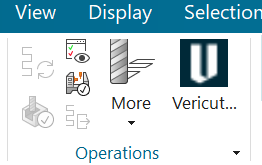
If you wish to have the Vericut  icon on the Siemens NX toolbar, follow the below steps.
Steps:
-
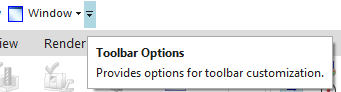
Select Toolbar Options
-
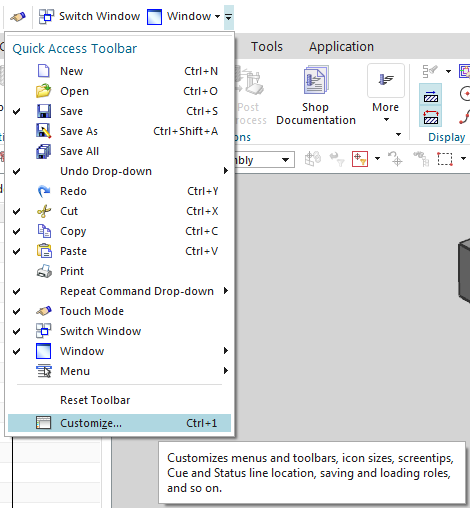
Customize
-
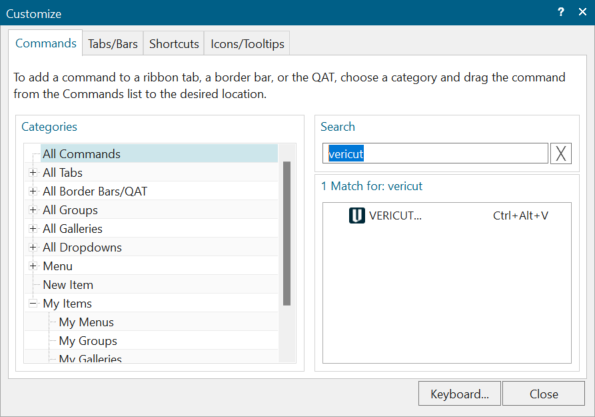
Search for Vericut
-
Drag and Drop command to desired location
-
Select Close
Microsoft Redistributables: Siemens NX Interface
The Siemens NX-to-Vericut Interface (CATV5) may require the installation of Microsoft Redistributables, specifically the Windows C++ run-time libraries. These libraries ensure compatibility and proper functioning of the interface, allowing seamless data transfer between Siemens NX and Vericut for manufacturing simulation.
Note: A runtime library is a collection of low-level compiler support routines and functions that are used by virtually all programs compiled with GCC (GNU Compiler Collection) and can be downloaded here.
Documentation: Siemens NX Interface
Overview: The Siemens NX interface exports manufacturing data from Siemens NX to Vericut, ensuring a seamless transition for simulation. It automatically configures the necessary Vericut setup requirements and launches the simulation, ready to play.
Vericut Simulation Setup Requirements: To run a successful simulation in Vericut, the following steps must be completed:
1. Select a VMC (Vericut Machine Configuration) – Define the machine setup for simulation.
2. Select and Orient Stock, Fixture, and Design Models – Ensure correct positioning of components.
3. Select NC Programs & Subroutines – Load the necessary machining programs.
4. Define Cutting Tools – Specify the tools used in the machining process.
5. Define Work Offsets Tables – Configure coordinate systems for accurate machining.
Accessing the Siemens NX Interface
To connect Siemens NX with Vericut/Optimizer, follow these steps:
-
Select Vericut
icon from the Siemens NX ribbon. -
Alternately, you can hold down the Ctrl key, hold down the Alt key and click the V key (Ctrl + Alt + V)
Important Note:
The Siemens NX interface requires an active NC Manufacturing file to function properly with Vericut.
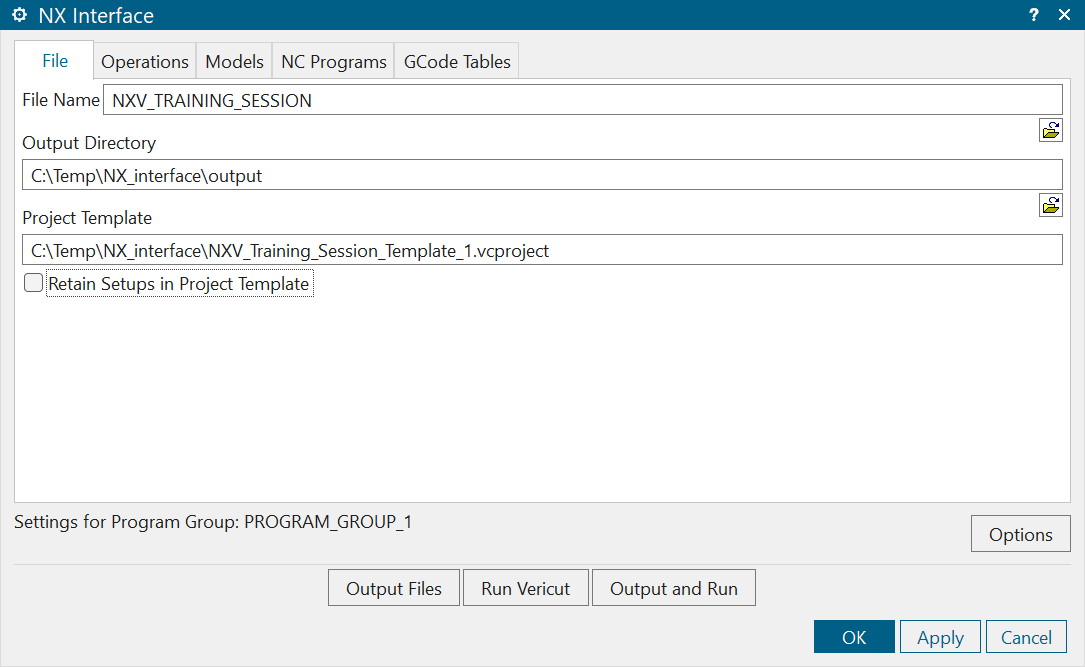
When you trigger NXV, you should see a window similar to this:
License Handling
- The interface checks out a license when opened.
- The interface checks in the license when closed.
File
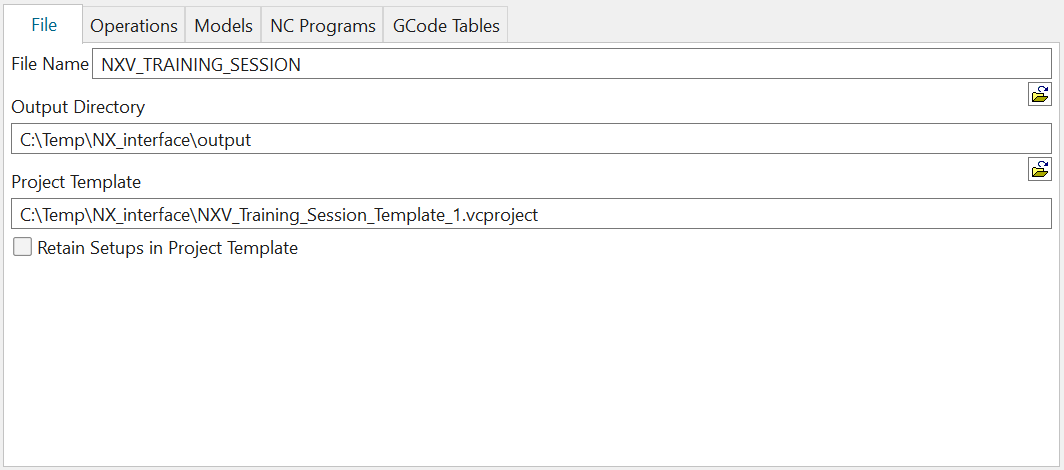
File Name: In the File Name text field, enter the "base" name for the Vericut files that will be created. By default, the base name of the NX .prt file is used.
Output Directory: NXV will generate several files to pass NX information to Vericut. All these files will be placed in a single folder. In the Output Directory text field, enter the /path/ to the directory where you want the Vericut files (.VcProject, .tls. CGTPart.stk, CGTStock.stk, etc.) output, or use the  button to display a file selection window and use it to specify the /path/. By default, the output directory is the "start in" directory of the NX session. Optionally you can set environment variable in the nx8.bat file.
Example: set CGTECH_NXV_OUTPUTDIR=C:\NXV_working_directory
Project Template: Enter the /path/filename of the "template" .VcProject file that you want loaded, in the text field, or use the button to display a file selection window and use it to specify the /path/filename. A Project Template is a previously defined Vericut .VcProject file that containing files and settings required for Vericut simulation. Optionally you can set environment variable in nx8.bat file.
Example: set CGTECH_NXV_PROJTEMPLATE=C:\NXV_working\NXV_Template.vcproject
Retain Setups in Project Template: Toggle “on” Retain Setups in Project Template to specify that you want to append the operations in the NX part file, to the setups that are already defined in your Project Template file so that setups from both files will be contained in the generated project file.
Operations
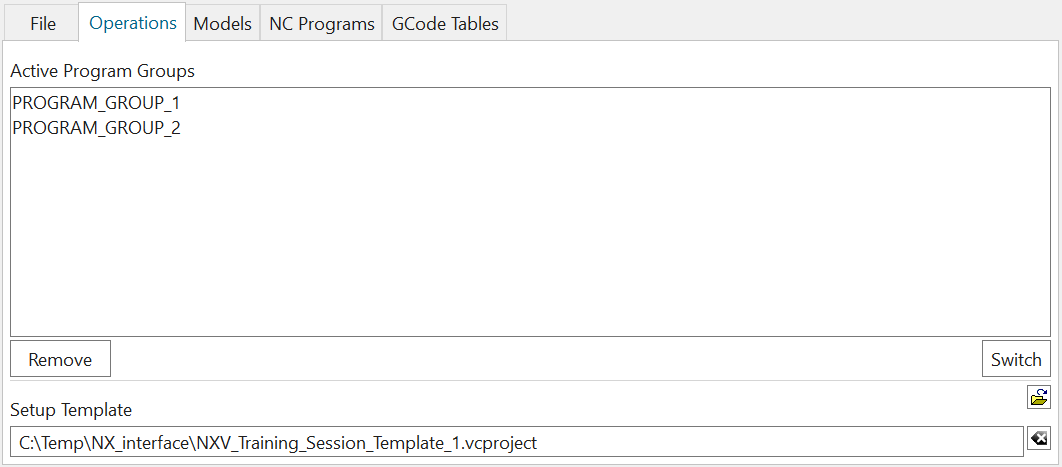
Active Program Groups: Select the name of the program group, from the Active Program Groups list, that you want to specify settings for. The "Settings For Program Group: program group name" will update to confirm your selection. Any settings that you make will apply to this program group until another program group is selected.
Remove/Restore and Switch Buttons: If there are some program groups that you do not wish to transfer to Vericut, select them on the Active Program Group(s) list and use the Remove button to move them to the Deleted Program Group(s) list. Click the Switch button to switch between displaying the Active Program Group(s) list and the Deleted Program Group(s) list. To restore previously deleted program groups to the Active Program Group(s) list, select them in the Deleted Program Group(s) list and click the Restore button.

Setup Template: If desired, enter the /path/filename of the Setup Template file that you want loaded, in the text field, or use the button to display a file selection window and use it to specify the /path/filename. A setup "template" is a previously defined Vericut.VcProject file that containing files and settings required for Vericut simulation. If this field is left blank the Project Template will be used.
Using multiple Vericut Setups (multiple Active Program Groups): For Multiple Setup Cut Stock Transition, the NX Interface automatically creates the necessary STOCK Csys in each Setup required to transition the Cut Stock from Setup to Setup. No need to select a "Stock Coordinate System" as NXV always uses the Absolute CSYS.
Models
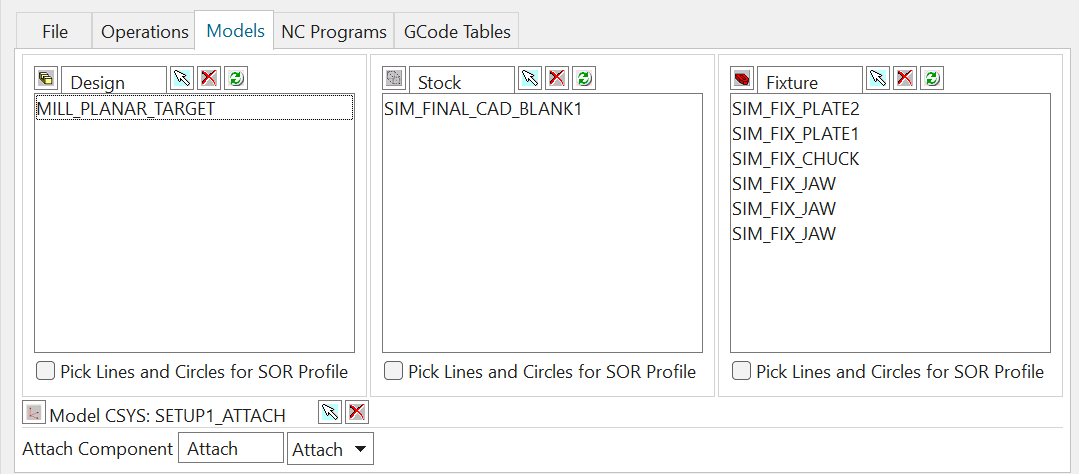
Geometry: By default, NXV automatically selects models associated with your NC operations. However, the following options can be used to select alternate geometry to use in the simulation.
Design: For each setup you should specify the names of the components in Vericut in which the design models will be placed. Default component names are simply Design
 (Highlight): By default, if you select a model from the design models list, it will be highlited in the NX Graphic area. Use the Highlight button to toggle Highlight or un-Highlight all design models from the list.
Stock: For each setup you should specify the names of the components in Vericut in which the stock models will be placed. Default component names are simply Stock
 (Highlight): By default, if you select a model from the stock models list, it will be highlited in the NX Graphic area. Use the Highlight button to toggle Highlight or un-Highlight all stock models from the list.
Fixture: For each setup you should specify the names of the components in Vericut in which the fixture models will be placed. Default component names are simply Fixture
 (Highlight): By default, if you select a model from the fixture models list, it will be highlited in the NX Graphic area. Use the Highlight button to toggle Highlight or un-Highlight all stock models from the list.
 (Select): Use this button open the Class Selection dialog box which lets you select objects based on the currently specified filter, mouse gesture, and selection rules. This button is used to select design, stock and fixture model(s) from the NX graphics area.
 (Remove): Use this button to remove the selected design, stock and fixture model(s) from the list.
 (Refresh): Use this button to clear the design, stock and fixture model(s) from the list, and re-read design, stock and fixture model(s) from the NX > Workpiece > Geometry
Model CSYS: NXV will automatically position the Part, Stock and Fixture models from MCS origin of Program Group to Vericut ATTACH component. If you wish to output the Part, Stock and Fixture models relative to a different coordinate system, click (Select), then select the coordinate system representing the orientation of the stock on the machine in Vericut. You must have previously set Output Model Relative To, on the Options window, to MCS/Coordinate System. All models will be output relative to the selected coordinate system.
Note: When selecting a coordinate system from the NX session, an MCS cannot be used.
Attach Component: The Attach Component is the Vericut component in which the coordinate system will be attached to.
Positioning Models in Vericut Using NXV's Model CSYS The placement of models in Vericut is determined by the NX Model Location coordinate system (Model CSYS). Specifically, For example SETUP1_ATTACH coordinate system in NX should be positioned to represent the intended origin of the model relative to the Vericut Attach Component.
This ensures that part, stock, and fixture models are aligned correctly within the Vericut simulation environment.
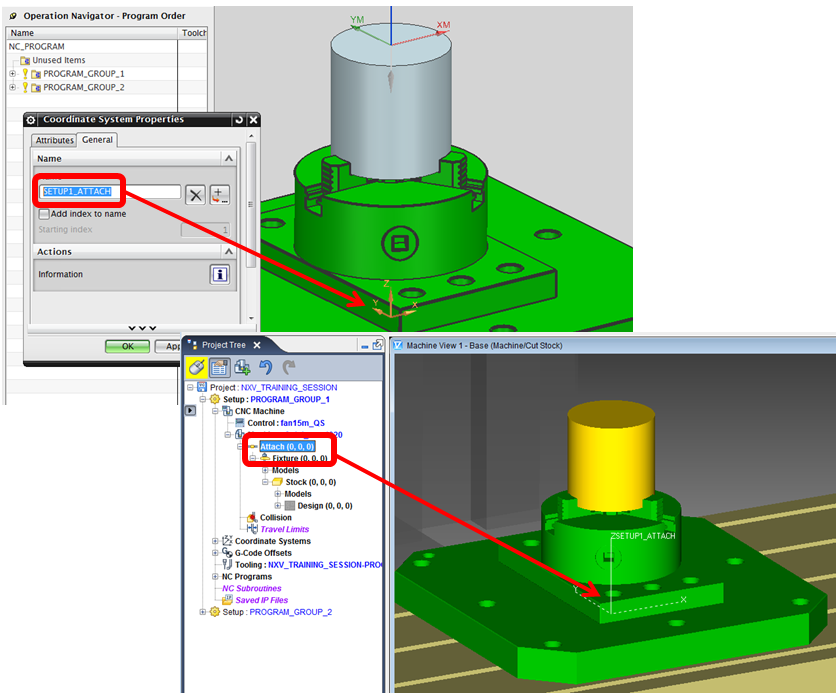
 (Highlight): Use the Highlight button to toggle Highlight or un-Highlight the Coordinat System which will be used for the Model CSYS feature.
Explanation on how the Workpiece > Geometry is currently used in NXV
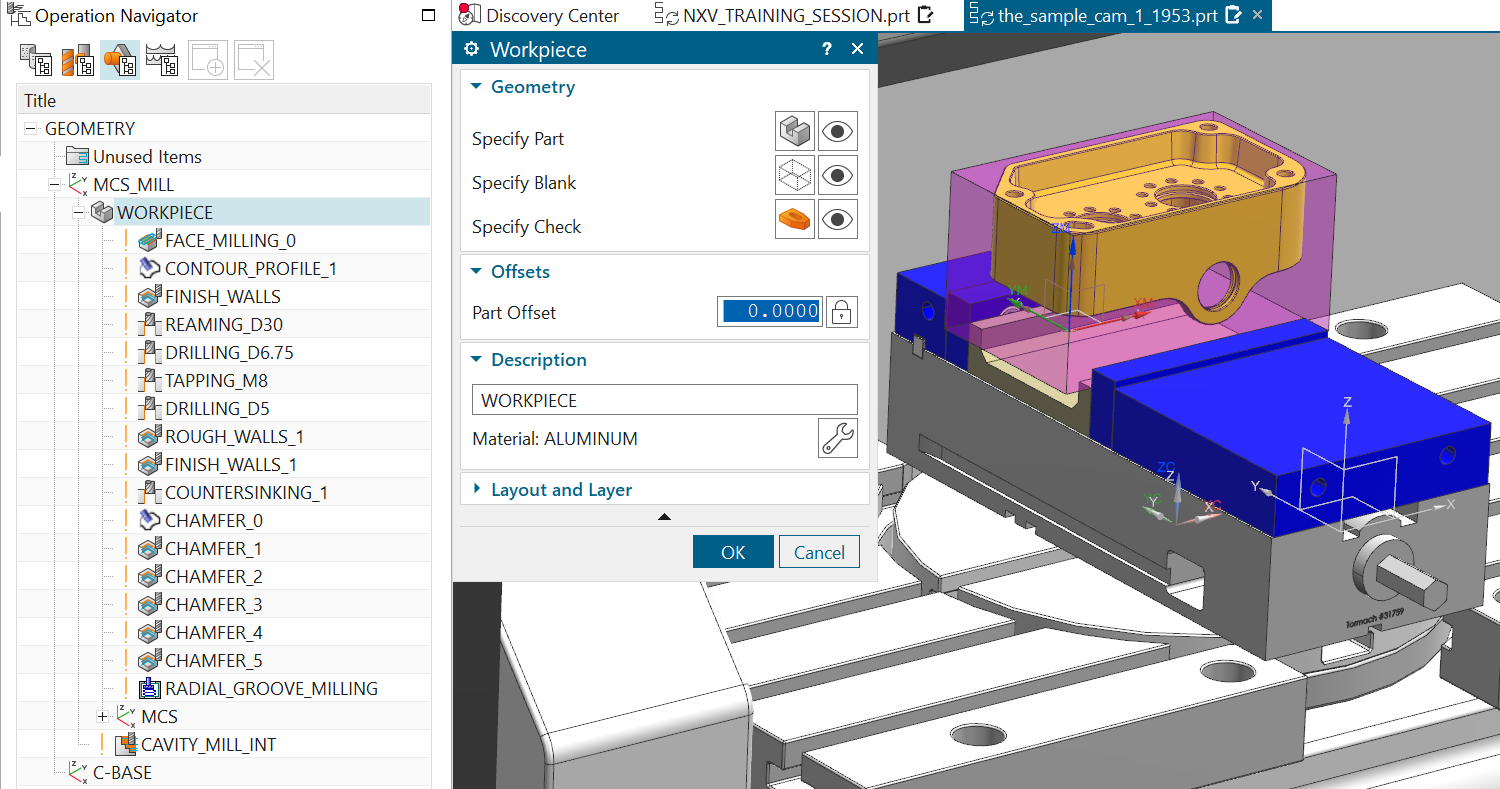
- The NX Interface identifies Operations (Program Groups) as top-level active program groups in the Program Order View tree of NX Operation Navigator. This is as it has always been. (Note that we have the option “List Toolpath Subgroups” in McamV which essentially lists all children of top-level program groups as separate operations; and we currently do NOT have such option in NXV).
- In each Program Group The NX Interface identifies its first non-group operation (which normally has a tool an a toolpath), such as VARIABLE_CONTOUR_COPY in PROGRAM_GROUP_1 in the NXV_TRAINING_SESSION.prt sample.
- For this first non-group operation The NX Interface identifies its parent geometry as can be seen in the Geometry View tree of NX Operation Navigator. This object also shows for the selected operation in the Geometry column of the operation row in the Program Order View.
- This parent object is typically either of the type ‘workpiece’ or ‘MCS’ (machine csys). If it is a workpiece The NX Interface uses it as the Program Group workpiece. If it is an MCS (as the case in NXV_TRAINING_SESSION.prt) we look at its parent geometry object (which is the grandparent of the first non-group operation) – if that object is a workpiece we use it as the Program Group workpiece.
- If The NX Interface successfully identifies a Program Group workpiece, It use its geometry as Program Group models.
- There is an option to ignore workpiece geometry, in which case Program Group workpiece objects are still identified but not used. A user can toggle this option and refresh model lists using the current setting.
NX model export explanation:
Non-solid models composed of surfaces, faces, etc. must form a watertight skin to be useful as solid models in Vericut. If gaps or overlaps exist in NX geometry, the resulting solid may have holes, or portions (possible all) of the model may fail.
NX IPW Model Usage: The NX IPW (In-Process Workpiece) model can be designated as the representative geometry for Stock, Fixture, or Design components within the simulation.
NC Programs
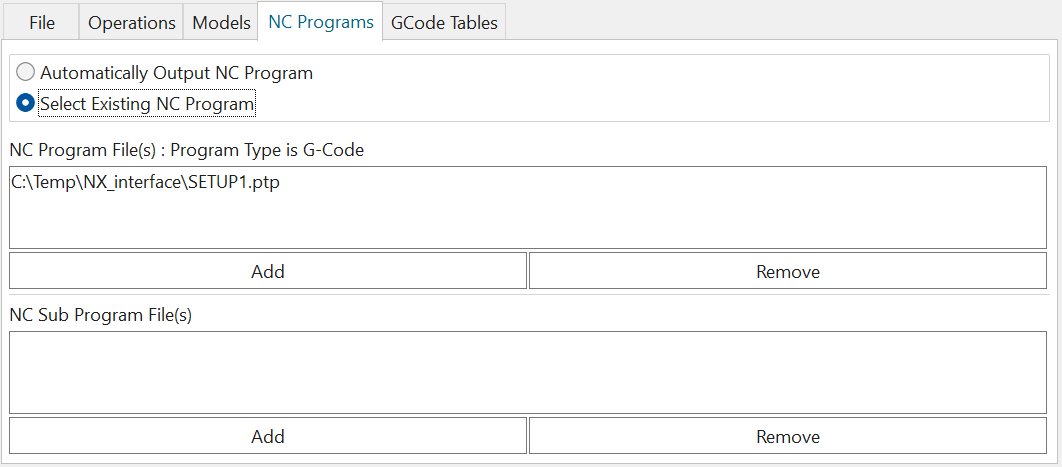
Automatically Output NC Program: To create a new NC program file to add to the NC Program File(s) list, select Automatically Output NC Program, and then select Add. NXV will automatically create a new .cls, or .ptp, file containing the operations related to the selected operations. If either the Program Group is selected, or no selection is made in the Operation
Navigator (ONT), NC code will be output for all operations. Otherwise, NC code will be output only for the operation(s) selected. NXV uses the settings in the Options window to determine whether a .cls file, or a .ptp file, is created for simulation.
Select Existing NC Program: To add an existing NC program file(s) to the NC Program Files list, toggle to Select Existing NC Program, and then select Add. NXV displays a standard file selection window enabling you to select existing files.
NC Program Files: Displays a list of NC Program files that will be passed to Vericut.
NC Sub Programs Files: Displays a list of NC Sub Program files that will be passed to Vericut.
NC Sub Programs cannot be automatically created, they have to be selected.
Add --- Use to add NC program/sub files to the NC Program/Sub Program File(s) list. When Select Existing NC Program is selected, NXV displays a standard file selection window enabling you to select existing files. When Automatically Output NC Program/Sub Program is selected, the configured NC code is output and added to the list.
Remove --- Use to remove the highlighted NC program file(s) from the NC Program File(s) list.
GCode Tables
The currently configured GCode Tables are displayed in the list below. The following buttons are used to manage the list of tables:
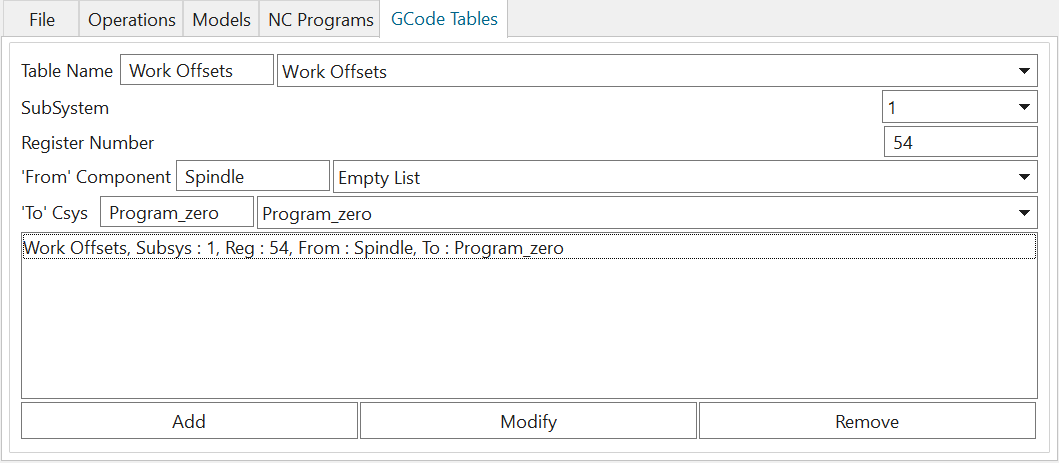
Table Name: Enter the G-Code table name or select it from the Table List pull-down list.
SubsystemID: Select the Subsystem from list.
Table List: The Table List pull-down list contains the following Vericut GCode tables: Work Offsets, Program Zero, and Base Work Offset.
-
The Work Offsets table is used to store the work coordinate system offset (fixture offset) values.
-
The Program Zero table is used to specify the programmed zero location of a GCode NC program file.
-
The Base Work Offset table is used to specify the location from which work offsets are based.
Subsystem: Use to specify the machine subsystem ID for which the table is being defined. Select the subsystem ID from the pull-down list.
Register Number: If Work Offsets was selected as the Table Name, enter the work offset register, for example 54, 55, 56, etc.
'From' Component: Enter the name of the component that represents the "from" point for determining the program zero offset or select it from the 'From' List pull-down list. Vericut will use the origin of the specified component. The default "From Component" is "tool".
'To' Csys: Enter the name of a CSYS to represent the \"to\" point for determining the program zero offset in the text field or select the CSYS name from the 'To' List pull-down list. Vericut will use the origin of the specified CSYS. The default "To Csys" is a CSYS named "Program_Zero" which is derived from the MCS coordinate system.
Add: Add the current GCode table to the list.
Modify: Modify the fields of the selected table by the current settings.
Remove: Delete the selected table(s) from the list.
Note: Data for the tables' selection lists is taken from the machine specified in the Setup Template.
Optimization
This tab is only visible when the environment variable OPTIMIZATION_ACTIVE=1 is set
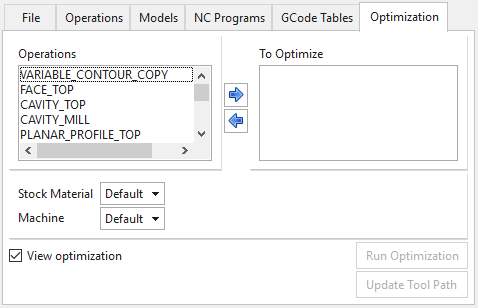
To Optimize: List of current toolpaths to be optimized after Vericut optimization
 moves NX Toolpath from Operations list to To optimize list
 moves NX toolpath from To optimize list to Operation list
Stock Material: Specifies the stock material being cut. The material name is changed via clicking the arrow and selecting from a list of available materials. List comes from Vericut template + selected Tool manager.
Machine: Specifies the NC machine being used to cut the workpiece. This feature functions similar to Stock Material described above.
Note: For optimization to occur, the Stock Material and Machine names must match those of the desired Optimization records in the Tool Library file.
View optimization: Toggle on (checked) to run Optimization in batch mode. Vericut will open at the end of optimization for monitoring.
Run Optimization: NXV creates a Vericut project ready to optimize state with CLS file program file type for all setups.
Update Tool Path: Updates selected NX tool path with optimized feed rate and add more cuts if needed after optimization.
Note:
A series a time and date check are performed to ensure synchronization between Vericut and NX data.
Settings for Program Group: "program group name" will update to confirm your selection. Any settings that you make will apply to this program group until another program group is selected.

Options

Operation Settings
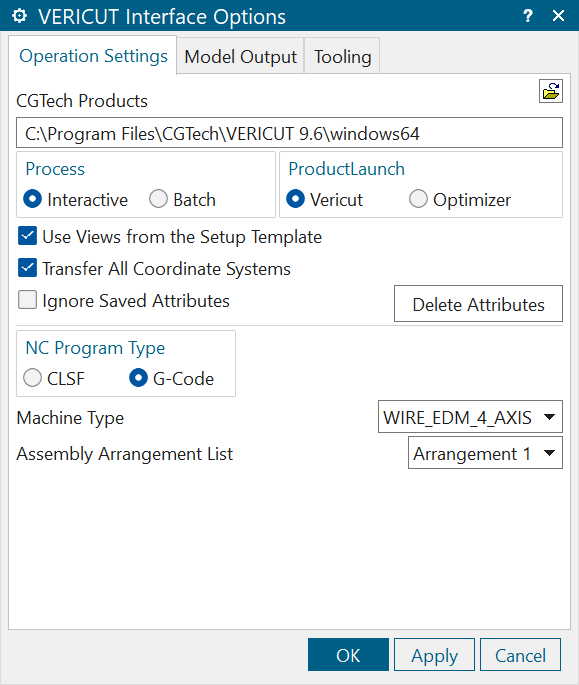
CGTech Products:
Allows you to change the directory used to launch Vericut/Optimizer from the interface.
Process: Controls the processing mode in which Vericut is run.
-
Interactive: Opens the Vericut window for access to all Vericut functions and capabilities. When the Vericut window opens, all of the required Vericut files are loaded and ready for processing. The stock is displayed in its unprocessed state and you need to press the "Play to End" icon in Vericut to start the verification process.
-
Batch: Runs Vericut unattended in the background. When the Vericut window opens, the toolpath verification process is complete and the part is displayed in its processed state.
-
NOTE: In either case, both application windows (Vericut and NX) are available to work in at the same time.
Product Launch: Select to launch the desired application, Vericut or Optimizer
Use Views from the Setup Template: When toggled "on"(checked), Vericut will use the views stored in the Setup Template rather than the views created by NXV.
Transfer All Coordinate Systems: When toggled "on" (checked), NXV transfers all NX coordinate systems to Vericut.
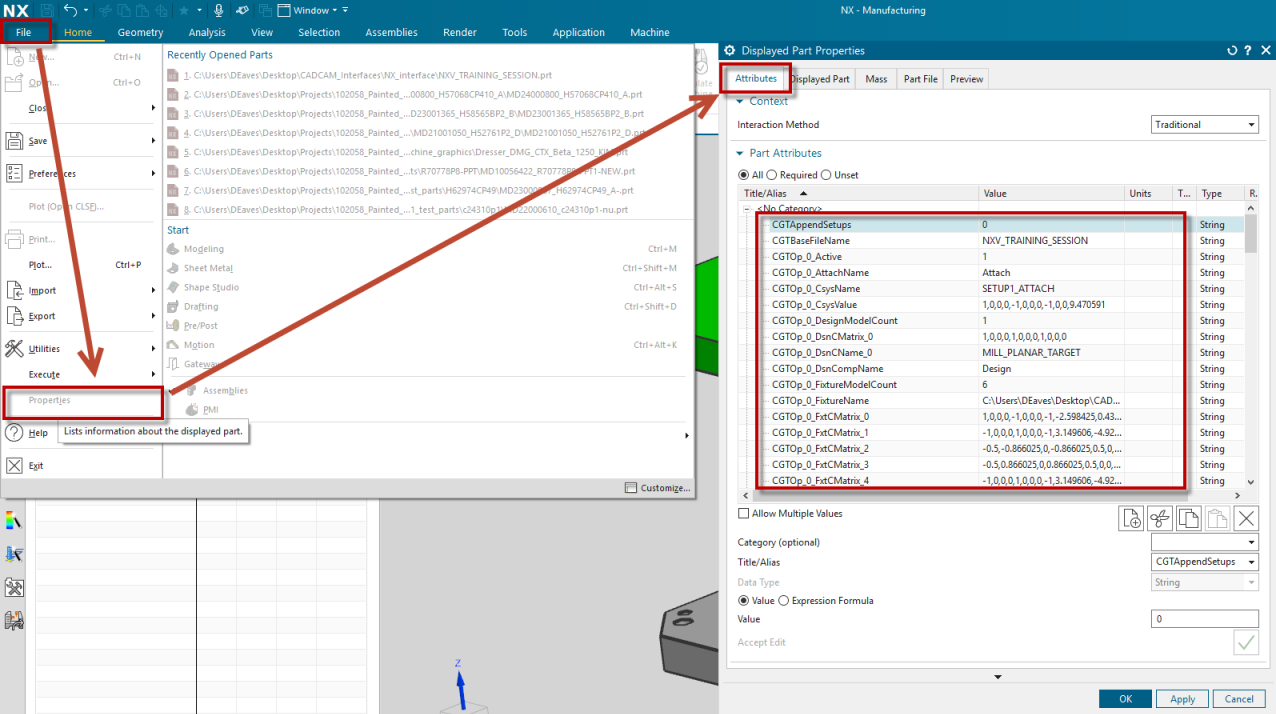
Ignore Saved Attributes: The values that you set in the NXV windows as attributes are saved in the NX part file so that when you save the part and later load it again. If the Ignore Saved Attributes is checked, NXV ignores all CGT-prefixed user attributes in the part. NX > File menu > Properties
Delete Attributes: If pressed, deletes all CGT-prefixed user attributes in the part. This button is only visible if CGTECH_SHOW_DELETE_ATTRIBUTES_BUTTON is set to 1
NC Program Type: Use to specify the type of NC program files that are to be passed Vericut. Choose either CLSF or G-Code. This feature is used in conjunction with the Create for selected operations feature on the NXV Vericut window.
Machine Type: Enables you to select the machine type that NXV is to use for creating G-Code files from the NX internal toolpath files.
Assembly Arrangement List: The Assembly Arrangement List feature displays a list of all NX Assembly Arrangements available in the current part file. Select the desired Assembly Arrangement from the list. If no Assembly Arrangements exist in the current NX part file, the pull-down list displays "None".
Model Output
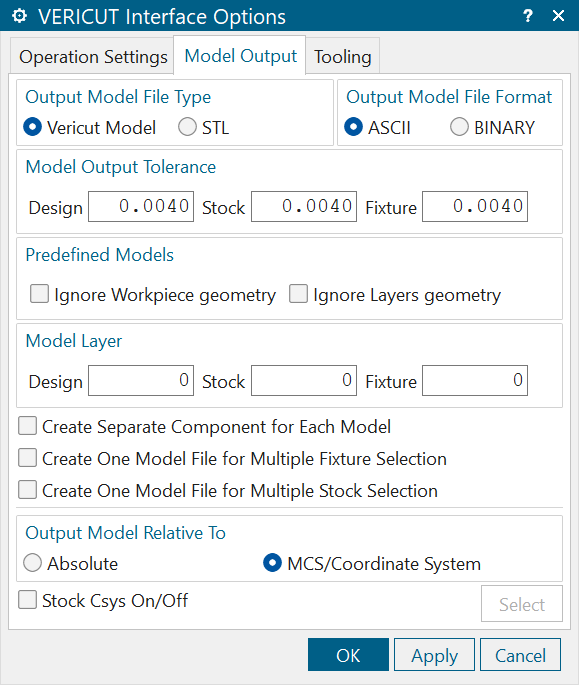
Output Model File Type: Use to specify the type of model files that are being passed to Vericut. Choose either Vericut Model (Vericut polygon file) or STL (Stereolithography model file).
Output Model File Format: Use to specify the file format of the model files. Choose either ASCII or Binary. The "Binary" Vericut polygon files are platform specific.
Model Output Tolerance: Use to specify tolerance values for Design, Stock and Fixture models.
Predefined Layers: - Ignore Workpiece geometry, with this option checked NXV ignores Design/Stock/Fixture models defined as workpiece geometry. - Ignore Layers geometry, with this option checked NXV ignores Design/Stock/Fixture models defined as Layers geometry.
Model Layer: Use to specify the Layer number to be used for Design, Stock and Fixture models defined as Layers geometry.
Create Separate Component for Each Model: When toggled "on" (checked), NXV will create a component for each stock/fixture/design model. All the components will be on the same level under the Attach component, disregarding the tree structure in the setup template.
Create One Model File for Multiple Fixture Selection: When toggled "on" (checked), NXV will transfer multiple NX fixture models to Vericut as a single model file.
Create One Model File for Multiple Stock Selection: When toggled "on" (checked), NXV will transfer multiple NX stock model to Vericut as a single model file.
Output Model Relative To: Model files are output relative to a specific coordinate system. Use to specify whether model files will be output to the Absolute or MCS/Coordinate System.
-
Absolute: The Absolute choice is typically used for CLSF files because the CL file MSYS record takes care of tool point location transformation. If Absolute is selected, the following is output in the setup file for this program group:
- Models are output relative to absolute.
- Vericut Process Matrix is turned-on.
- A Vericut Csys is created for each MCS in each Program Group, attached to the stock component.
-
MCS/Coordinate System: The MCS/Coordinate System choice outputs the models relative to the MCS of the first operation in the program group, or relative to the selected coordinate system (new), if one exists. This choice is typically used for G-Code processing since there is no MSYS equivalent in the G-Code data. It is sometimes used by CLSF users when they only have one setup, and want the models located relative to the MCS, rather than absolute. If MCS/Coordinate System is selected, the following is output in the setup file for this program group:
- Models are output relative to the selected Program Group\'s MCS,
or ... - Models are output relative to the selected coordinate system.
- Vericut Process Matrix is turned-off
- A Vericut Csys is created for each MCS in each Program Group, attached to the stock component.
Note: MCS/Coordinate System output is sometimes used for a single-position CLSF where the user wants the models in the same coordinates as the MCS.
- Models are output relative to the selected Program Group\'s MCS,
Stock Csys On/Off: When the check box "Stock Csys On/Off" is checked the user can press "Select" to select the "Stock Csys" coordinate system. The currently selected "Stock Csys" coordinate system is highlighted, and the user can reselect it if he wishes. If the check box "Stock Csys On/Off" is checked, the currently selected "Stock Csys" coordinate system will be output with the name "***STOCK***" and used for cut stock transition. If the check box "Stock Csys On/Off" is unchecked, no "***STOCK***" coordinate system will be output.
Tooling
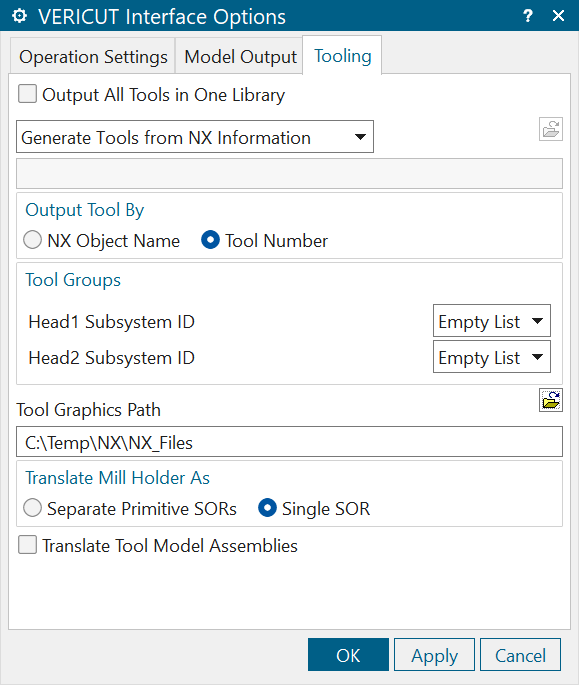
Output All Tools in One Library: Typically you would have NXV generate tool libraries (with the ".tls" extension) from the tool data in the NX part file for each setup. Alternatively, if you choose to create a single tool library for all setups, click on the Output All Tools in One Library check-box.
Select one of the following Tools options from the pull-down list:
- Generate Tools from NX information: Choose this option to have NXV create a tool library using the tool data in NX.
- Merge Tools into Setup Template Tool Library: Choose this option to merge the tool library created by NXV, with the tool library file stored in the Setup Template, and use the "merged" tool library rather than one created by NXV.
- Use Tools from the Setup Template: Choose this option to use the tool library file stored in the Setup Template instead of one created by NXV.
- Use Selected Tool Library: Choose this option to specify a specific tool library to use.
Enter the \path\filename of the tool library file in the text field or use the button to display a file selection window and use it to specify the /path/filename of the tool library file.
Output Tools By: Use to specify whether you want to output tools named with the NX Object Name (Default) or named with the NX Tool Number. Choose NX Object Name if you want the tool to have the NX object name as the Tool ID in Vericut. Choose Tool Number if you want the tool to have the NX tool number as the Tool ID in Vericut.
Tool Groups: Use to match Vericut subsystems with NX tool groups. This is needed to create the tool-change list. Used only when different tool groups are defined in NX, for turning or mill-turn machines.
Tool Graphics Path: Used to enter/change the Tool Graphics Path using the corresponding text box or the button.
Translate Mill Holder As: Enables you to specify whether to transfer an NX holder definition as individual SORs for each step or as a single SOR representing the complete holder:
- Separte Primitive SORs: Each Step in the NX holder definition is transferred as a separate SOR.
- Single SOR: The NX holder definition is transferred as a single SOR.
Translate Tool Model Assemblies: When toggled "on" (checked), the NXV interface automatically creates a Step file for each referenced tool assembly; which can be processed by the CAD Import dialog in the Vericut Tool Manager. When toggled "off" (not checked), 3D assembly components are translated as faceted solid models (using the settings in the Options window) and these models are output as the tool components. If a tool assembly component has the name "CUT" the corresponding Vericut tool component will be "Insert", otherwise it will be "Holder". This is designed to enable the NXV interface to identify the Vericut tool component type for each NX tool assembly solid component. When toggled "off" (unchecked), NXV uses an NX SOR-like representation of the tool assembly as the tool component.
Generate buttons

Output Files: Outputs tool library files, Vericut setup files (ops and vctmp). It does not create a Vericut Project file not output model files.
Run Vericut: launches Vericut with the files created by Output Files.
Output and Run: Use Output and Run to output the files needed by Vericut. It outputs tool library files, Vericut setup files (ops and vctmp) and then launches Vericut (which creates a Vericut Project file) all with one click.
OK: Saves values that you set in the NXV windows as attributes the NX part file and closes the NXV Vericut window.
Apply: Saves values that you set in the NXV windows as attributes the NX part file and leaves the NXV Vericut window open to enable you to continue.
Cancel: Closes the NXV Vericut window without saving any of the settings in the NX part file.
Preferences
Preferences File
Also known as 'prefs' file, stores all user specified 'global' settings for interface operation. The settings stored are called 'global' because they are responsible for overall look & feel and operational behavior of the interface. They are not tied to any specific NX project. By default, 'Preferences' file is generated at:
C:\Users\username\nxv_version_user.prefs.
NXV Attributes
Values configured in the NXV dialog (custom data) are stored directly within the NX part file. When the part is saved and subsequently reopened, these attribute values are automatically restored in the NXV interface.
NX stores part-specific attributes under the following menu path: NX → File → Properties