Layout
Location: View tab > Layout group
The command buttons in the Layout tab control how many views of the Vericut model are seen, and how they are arranged. All views are contained within the Vericut Reviewer main window.
One view is considered by Vericut Reviewer to be the "active view". A view is made active by clicking in it, and is designated by a colored window header. Many Vericut Reviewer functions are effective only in the active view, including most viewing functions.
Standard — Sets views of the Vericut model to one of the standard view layout choices. By default standard view layouts are tiled, but you can change this using other functions in the Layout group, or via standard window management features, such as dragging, resizing, etc.
| Single View Layout |  |
|---|---|
| Two View Layout (Horizontal) |  |
| Two View Layout (Vertical) |  |
| Three View Layout (Vertical) |  |
| Three view Layout (Horizontal) |  |
| Four View Layout |  |
📝 NOTE: If you currently have a Single View Layout and change to a Two View Layout (either Horizontal or Vertical) Vericut Reviewer will add the view with the type as defined below:
-
If the single view is a Workpiece view, the added view will be a Machine view.
-
If the single view is a Machine view, the added view will be a Workpiece view.
If the default view is not the view type that you want, right mouse click in the added view and select View Type > desired view type (Workpiece, Machine, or Profile) from the right mouse button shortcut menu.
💡 Tip: You can also use the corresponding view layout icons in the Toolbar.

See Changing the View Layout, under Using View Layout Features, also in the View tab section of Vericut Reviewer Help for information additional information.
Add View — Adds a view. You can add as many views as desired. What is seen in a view (workpiece, machine, etc.) is determined by the view attributes (ref. View Attributes window, also in the View tab section of Vericut Reviewer Help. Reposition, or resize, views via dragging the view window header, sides, or corners.
💡 Tip: You can also right mouse click in a view and select Add a View > desired view type (Workpiece, Machine, Machine, or Profile) from the right mouse button shortcut menu.
↘️ Shortcut: You can quickly change the attributes or orientation of a view by right-clicking in the view, and selecting from the displayed menu. See the Graphics Area Right Mouse Button Shortcut Menus, in the Getting Started section of Vericut Reviewer Help for more information.
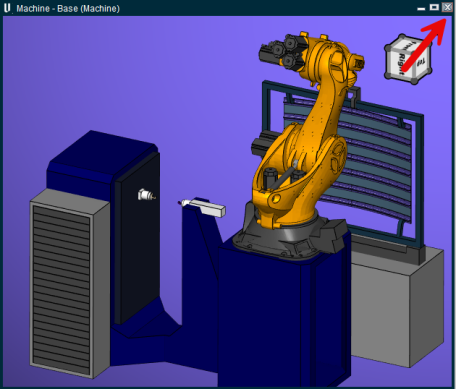
Delete View — Deletes a view (view must first be active. To activate a view, left-click inside the view you want to be active). You can also delete a view by clicking "X" at the top right corner of the view window.
Cascade — Cascades views in an overlapping arrangement. Note that cascaded view layouts are not saved by Vericut Reviewer.
📝 NOTES:
-
The Cascade view feature is not available in Vericut Reviewer when the review file was created with Hardware Graphics Acceleration (OpenGL) active in any of the views.
-
The Cascade view feature is not available in Vericut Reviewer when the review file was created in Vericut Drill and Fastener Simulation or Vericut Composites Simulation since Hardware Graphics Acceleration (OpenGL) is always active.
Tile Horizontally — Tiles views in a horizontal arrangement.
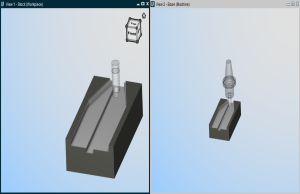
Tile Vertically — Tiles views in a vertical arrangement.
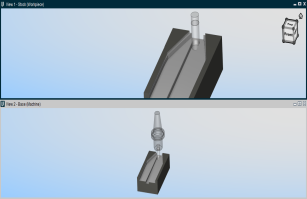
See Tiling Views, under Using View Layout Features, also in the View tab section of Vericut Reviewer Help for information additional information.
View to Back — Moves the "active" view to the back. This function can also be accessed using the right mouse button in the active view or by using the  (View To Back) icon in the Toolbar.
View to Front — Moves the selected view to the front. Selecting "View to Front" displays a list of all available views allowing you to select the desired view to be moved to the front even if it is obscured by other views in the graphics area.
Always in Front — Makes the active view remain "always in front" until it is specifically moved to the back or until another view is specified as "always in front". This function can also be accessed using the right mouse button in the active view or by using the  (Always in Front) icon in the Toolbar.
Using View Layout Features
The options in the Layout group control how many views of the Vericut model are seen, and how they are arranged. All views are contained within the Vericut Reviewer main window. The size and orientation of the model in each view is individually controlled.
Changing the View Layout
Use the procedure described below to change the view layout in Vericut Reviewer.
In the Vericut Reviewer main menu ribbon, go to View tab > Layout group.
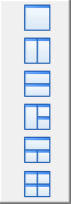
Choose the option that provides the desired view quantity and layout.
| Name | Image |
|---|---|
| Single View Layout Two View Layout (Horizontal) Two View Layout (Vertical) Three View Layout (Vertical) Three view Layout (Horizontal) Four View Layout |
 |
💡 Tip: You can also use the corresponding view layout icons in the Toolbar.

With the view layout set, additional views can be added, or views can be deleted from the current layout using other command buttons in View tab > Layout group.
Drag or resize any of the view ports in the Vericut Reviewer main window as desired via dragging the view port window header, sides or corners.
Tiling Views
Use the procedure described below to arrange views in a tiled layout. Example arrangements are shown below.
| Description | Image |
|---|---|
| Tiled Horizontally | 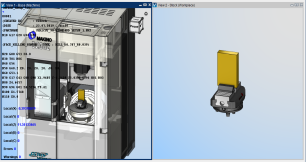 |
| Tiled Vertically | 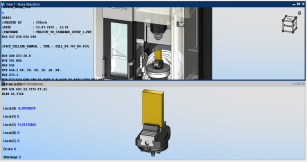 |
After any of these operations, you can reposition, or resize, any of the views via dragging the view window header, sides or corners.
To tile views horizontally:
In the Vericut Reviewer main menu ribbon, select View tab > Layout group > Tile Horizontally.
The view ports are arranged in a horizontal tiled arrangement as shown in the picture above.
To tile views vertically:
In the Vericut Reviewer main menu ribbon, select View tab > Layout group > Tile Vertically, depending on the desired orientation.
The view ports are arranged in a vertical tiled arrangement as shown in the picture above.